Tuesday, January 13, 2009
I Can't Believe Anyone Would Think It's Patentable
A MacNN news item divines a possible merger of calendar and map functions on the iPhone from an Apple patent filing. My marginal propensity to consume Apple-branded electronics is at least as high as the next person's, but nevertheless if Apple is granted this patent then the USPTO is fundamentally broken.
At issue is how the hell can this pass muster for novelty and non-obviousness? Inter-application communication — sending data from application A to application B — is old hat, as is combining the functions of applications A and B into Application C. This post, for instance, is written with an application (Firefox 3) that combines functions of e.g. a Web browser and RSS reader. So there has to be something extra-special about the choice of applications A="calendar" and B="map program." If you tell me that someone with ordinary skill in the art wouldn't envision the combination, then I'd laugh at you and then you'd tell me I'll never make it in patent law.
Regardless, Apple's application seems about as patentable as a Method and Apparatus for Text Entry and Editing on a Digital Computer would have been in recent prehistory. They deserve such copyright protection as is available for their code, and to be exposed to the rigors of competition otherwise.
Labels: Apple, Intellectual Property, technology


Tuesday, March 04, 2008
Annals of Reporting on Intellectual Property Disputes
The NYT published an article on the ongoing Scrabulous dispute, reminding us that Hasbro and Mattel "own the rights" to the game and:
denounced Scrabulous as piracy and threatened legal action against its creators, two brothers in Calcutta named Rajat and Jayant Agarwalla who run a software development company. Both Hasbro and Mattel said they were hoping for a solution that would not force them to shut down the game.There's evidently dissension among the IP holders' ranks, as:
Nearly the only "expert" opinion offered is this:Harold Zeitz, senior vice president for games at RealNetworks, said Friday that he was working closely with the Agarwalla brothers to bring the official Scrabble game to Facebook users.
Hasbro, meanwhile, said in a statement that Electronic Arts was planning to release an online version of Scrabble this spring. And Mattel, which signed a deal with RealNetworks last July, says that settling with the Agarwallas would set a bad precedent.
After 25 years with the National Scrabble Association, John D. Williams Jr., the executive director, said he had seen numerous copyright infringements of Scrabble, but the Scrabulous program on Facebook was the most “widespread and intense.” [emphasis mine]Then comes a related entry in the DealBook blog, with some dish on the source of a holdup in the negotiations between the Scrabble rights holders and the Agarwallas:
Still, they are now taking in $300,000 a year and, according to Silcion [sic] Alley’s back-of-the-envelope calculations, with a 10- to 20-times-revenue multiple that would make Scrabulous worth $3 million to $6 million. Allowing for a what the blog calls “a hockey-stick growth curve,” it could be worth more than $10 million, Silicon Alley said.
But according to the publication, again citing an anonymous source, “the brothers want a ‘multiple of several times that’ $10 million, and the four corporations they’re negotiating with think that’s ridiculous.”
Maybe so, but let me tell you what: in copyright disputes, it is highly unusual (to put it mildly) for rights holders to negotiate what they're going to pay the alleged infringers; cf. RIAA versus the world. It would have been informative had the NYT talked to someone who could discuss just what it is Hasbro and Mattel purport to own that puts them in this situation.
Labels: Intellectual Property
Wednesday, January 16, 2008
Our frequently-inactive game may never end
While looking for the Tom-Cruise-defends-Ron-Hubbard's-poker-game-idea video at Gawker, I find that the world of Facebook may be about to get a little less interesting, if that's possible:
Hasbro and Mattel, co-owners of Scrabble, asked Facebook to remove its one good app, "Scrabulous."
It's time for everyone to SuperPoke all the Hasbro and Mattel people—with what is left to your imaginations.
Personally, I'm with Gawker commenter Voxpopuli:
Scrabulous is the only reason I log into facebook daily, instead of weekly, so they'd better not shut it down.
God, I am such a geek.
Tom Adds: Interestingly, a U.S. Copyright Office page linked by one of the Save Scrabulous Facebook groups points out that games receive little protection under the otherwise content-provider-friendly U.S. copyright law:
Copyright protection does not extend to any idea, system, method, device, or trademark material involved in the development, merchandising, or playing of a game. Once a game has been made public, nothing in the copyright law prevents others from developing another game based on similar principles.Some material prepared in connection with a game may be subject to copyright if it contains a sufficient amount of literary or pictorial expression. For example, the text matter describing the rules of the game, or the pictorial matter appearing on the gameboard or container, may be registrable.
In short, merely knocking off a game's concept or even the full system described by its rules is legal. Mattel's case against the Scrabulous brothers, to the extent they have one, would be for misappropriation of Scrabble IP protected by trademark. Since the Agarwalla brothers don't republish the original rules or any distinctive gameboard artwork on Facebook, any copyright claims would appear to be weak.
Lots of commenters out there are suggesting that a settlement involving licensing of the Scrabble trade dress would be a reasonable outcome. Since nothing would really stop the Agarwallas from just changing the Scrabulous name and moving on, it's probably the profit-maximizing outcome for Hasbro and Mattel, too.
Labels: Intellectual Property, just life
Saturday, November 10, 2007
Saturday Random Ten
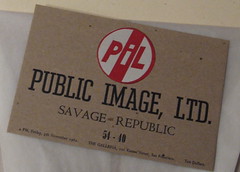
(Above: Reproduction of 1982 show flyer, from letterpress ephemera included in Bruce Licher's Independent Projects, 1989.)
1. Wire, Mr. Suit, Pink Flag
2. Heidi Berry, Firefly, Creation Purple Compilation
3. Sebadoh, Rebound, Bakesale
4. Manifesto, Pattern 26, Manifesto
5. Savage Republic, The Ivory Coast, Tragic Figures
6. Biff Bang Pow!, She Shivers Inside, The Girl Who Runs The Beat Hotel / Pass The Paintbrush, Honey
7. Eric Matthews, Fanfare (Reprise), It's Heavy In Here
8. Robyn Hitchcock, Brenda's Iron Sledge, Black Snake Dîamond Röle
9. The Lightning Seeds, Pure, Cloudcuckooland
10. The Pooh Sticks, Radio Ready, Formula One Generation
It's a tough week for the U.S. iTMS and eMusic, as rights-related difficulties or something puts the Esoterica Index at a solid 0.6. "Pure" was a top-20 single in the UK, and can be had from the UK iTMS, along with "Mr. Suit" on a collection of '77-'79 Wire classics. Remarkably, "Pure" is not included in a Lightning Seeds "collection" on iTMS Canada. This is where economists would tend to say, "stupid lawyers [and/or agents]," since making these items available in the U.S. would be all but gravy for someone given that they've already been processed for sale in the UK; Apple, no doubt, also has the technology to remit proceeds from U.S. sales to UK rights-holders. A legal download of a good Biff Bang Pow! greatest hits set is available for £7.99 direct from Rev-Ola Records, but it doesn't include the above track and I don't count stuff you actually have to go searching the open intertubes for.
Labels: Intellectual Property, Music, Random Ten
Friday, August 03, 2007
A Fine Line Between Clever and Stupid
The Australian heavy-metalers AC/DC have decided that they are too good for the iTunes Store and have hitched their star (*) to Verizon — just as Apple has announced that the iTunes Store moved its last billion tracks in just about 6 months:
Anyone can visit Verizon and buy AC/DC music, but there is a catch. Verizon is not allowing you to buy individual AC/DC songs, rather forcing people to buy entire albums. That means if you want to download the song and bang your head to the AC/DC song “Shoot To Thrill” you’ll have to buy the entire Back In Black album. Back In Black the album through Verizon will run you $11.99 compared to the CD on Amazon that is $9.97. The only track available as a single download is “You Shook Me All Night Long.” That is also the only song Verizon Wireless subscribers will be able to buy and download using their mobile phones.
Compare Charlie Stross:
One of my points was that, from a reader's point of view, ebooks are worth somewhat less than paper books — and ebooks with Digital Rights Management [DRM] are worth even less than that.I'm not in the market for that £3 expenditure, but that's just about the right idea. Verizon's music FAQ list implies that their wares are much more restrictively DRM'ed than Apple's 99-cent tracks. Following Stross's (correct) reasoning, the Verizon DRM'ed AC/DC should be priced below the unrestricted CD. Forcing buyers to take the whole album — not to mention cutting out owners of a certain popular line of digital media player — would be expected to drive some customers who might be willing to pay 99 cents each for a track or two to forms of file sharing that bring the artists no marginal revenue. (The icing on the industry's late-90s cake [pdf] was some substitution of much higher-valued CD album sales for then-collapsing single sales; broadband access to the Intertubes and Napster put an end to that.)
However, the big publishers continue to publish ebooks with DRM at a price that's typically the same as, or at most 15% lower than, the most expensive dead tree edition of the book that's currently on sale. (This leads to the amusing situation that if you are so inclined, you can pay $24.95 for a DRM'd ebook of Accelerando. Or not.)
However, Orbit listened to me, and they decided that if their paperback edition of The Atrocity Archives retails for £6.99, they'd like to find out how many people would be willing to buy an ebook of The Atrocity Archives for £3.00 — half the price [sic].
(*) I'm not being totally sarcastic here; Back in Black sells impressively for a catalog album, though if AC/DC was going to give a big revenue boost to Verizon's non-ringtone music sales, then Verizon's music business would have to be trivial.
Labels: Intellectual Property, pop music
Thursday, May 03, 2007
Transitions Post
We're back at Willow Valley, which in the intervening year has moved on to offering free WiFi in all areas. (And now on to Hershey Park, with the same amenity.)
Multiple transitions recently: pretty much everything except marriage/divorce and buying a new house (though we did complete the refi). A few more to come, so posting will be spotty.
But, especially since Tom referenced it, I want to post the beginning of this "lost post":
It's no secret that I disagree with Mark Cuban on the details of IP costing and benefits. (This and $2.00 gets you on the NYC subway, which I take much more often than Mr. Cuban, in part because he has made a lot of money from IP.) But we are completely agreed on the principle: if your content isn't available, no one will pay for it.
It's the reverse of that I want to consider today.
Tom dealt quite well with the absurdity of Cuban's example. Music videos, after all, are charged back to the artist, no less. But the question of how to make content "available" is rather more expansive than Cuban allows.
For instance, the first thing the folks of my hometown (defined as the place from which one graduated high school) were told when Visteon (nee Ford) announced they were closing the plant (to which many of our families were relocated ca. 1966-1968) is that the town is Valuable because of its Workers.
You know, the same Workers who are now out of jobs because Visteon decided they couldn't get enough value from the plant. So all that "available" content remains unused.*
This is hardly a unique situation. Check out any of Save the Rustbelt's posts about Ohio at AngryBear. What is interesting is that the first thing the Consultants do is come in and assure the workers (read: voters) that It's Not Their Fault.
Which is a good message. And, especially in this case, largely True. (The unemployed workers, after all, are not the Ford executives whose CF strategy put the company in its current situation.)
More later.
*Update: Apparently, there is now a plan for an ethanol processing plant. Considering the cost, in both senses, of using ethanol as fuel (as Tom has documented), this will allow the workers to Demonstrate their Value only if one double-counts the government subsidy. So much for Proud and Independent.
Labels: Economic Development, full employment, Hershey Park, Intellectual Property, just life, refinance, Willow Valley

