Wednesday, April 02, 2008
Don't Say You Didn't Get Anything From the Bailout
by Tom Bozzo
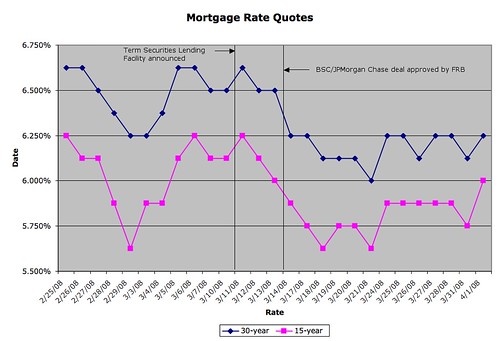
I've shown the FRB announcements of the Term Securities Lending Facility and of the approval of the BSC/JPMorgan Chase deal. Particularly after the latter, the 30-year rates (on a zero-point cash-out refi with 80% LTV) appear to have dropped around 37.5 bp from the previous range; let's call the sustained drop for someone who can afford a 15-year amortization 25 bp. So there's a little something for Main Street, though these rates aren't near the historic lows that are sometimes credited as a "fundamental" factor behind the house price run-up (in my not-so-extended family, there's at least one 15-year mortgage where the first digit of the rate is a 4).
Whether this will turn out to be worth more to the public than MBS losses flowing through the Fed to the Treasury remains to be seen.
Here's another update to a recent post, in which I sought to figure out what was in the recent efforts by out monetary policymakers to deal with the housing troubles for me — relatively responsible borrower who still (probably) has a fair amount of home equity. Initially, the answer seemed to be Sod All, but that's changed a little, as you can see from the updated graph:
I've shown the FRB announcements of the Term Securities Lending Facility and of the approval of the BSC/JPMorgan Chase deal. Particularly after the latter, the 30-year rates (on a zero-point cash-out refi with 80% LTV) appear to have dropped around 37.5 bp from the previous range; let's call the sustained drop for someone who can afford a 15-year amortization 25 bp. So there's a little something for Main Street, though these rates aren't near the historic lows that are sometimes credited as a "fundamental" factor behind the house price run-up (in my not-so-extended family, there's at least one 15-year mortgage where the first digit of the rate is a 4).
Whether this will turn out to be worth more to the public than MBS losses flowing through the Fed to the Treasury remains to be seen.
Labels: High Finance, monetary policy, Personal Finance Advice of Alan Greenspan


Thursday, March 13, 2008
What's In This Crisis for mE?!
by Tom Bozzo
As it happens, no. Or at least, not yet.
Since the Fed's interventions have gone into high gear — this really being an uncontained crisis and all — I've been tracking mortgage rate quotes from our bank. While they're not necessarily the lowest-price lender around, it so happens that we currently pay them (or their successors in interest) a weighted average interest rate of around 6% before taxes on our home-related debt, which is mostly the fixed-rate first mortgage. There was, maybe, one day since I started looking when we theoretically could have done a refi for a lower rate than we're paying now. Since then, not so much, as seen from the last 20 days of data (this is for a cash-out refi with ~80% CLTV, no points):

So, as you can see, we've had $400 billion in actual and/or promised unconventional Fed intervention, and a refi would cost me 50 bp more than I'm currently paying. Perhaps more to the point, what I'd pay today, post-intervention, is 25 bp more for a 30-year loan (37.5 bp more for the 15-year) than I'd have paid had I for some reason correctly picked the last three weeks' trough.
Happily, I do have an option to convert the HELOC to a fixed rate, which I expect soon will be at the contractual minimum (lower than the first mortgage!), for a nominal fee. So I suppose I'll be able to thank Chairman Ben for something.
OK, we will get an $1,800 loan that mostly will be paid back by the children. Otherwise, though, we're (knock on wood) not only in no danger of foreclosure but even ought still to have a fair amount of equity in the old homestead. So we're not exactly in line for any pending handouts to strapped homeowners. But at least we ought to be able to refinance on attractive terms, no?
As it happens, no. Or at least, not yet.
Since the Fed's interventions have gone into high gear — this really being an uncontained crisis and all — I've been tracking mortgage rate quotes from our bank. While they're not necessarily the lowest-price lender around, it so happens that we currently pay them (or their successors in interest) a weighted average interest rate of around 6% before taxes on our home-related debt, which is mostly the fixed-rate first mortgage. There was, maybe, one day since I started looking when we theoretically could have done a refi for a lower rate than we're paying now. Since then, not so much, as seen from the last 20 days of data (this is for a cash-out refi with ~80% CLTV, no points):
So, as you can see, we've had $400 billion in actual and/or promised unconventional Fed intervention, and a refi would cost me 50 bp more than I'm currently paying. Perhaps more to the point, what I'd pay today, post-intervention, is 25 bp more for a 30-year loan (37.5 bp more for the 15-year) than I'd have paid had I for some reason correctly picked the last three weeks' trough.
Happily, I do have an option to convert the HELOC to a fixed rate, which I expect soon will be at the contractual minimum (lower than the first mortgage!), for a nominal fee. So I suppose I'll be able to thank Chairman Ben for something.
Labels: monetary policy, Personal Finance Advice of Alan Greenspan
Thursday, January 31, 2008
The "Washington Consensus" doesn't apply to Washington
by Ken Houghton
My HELOC is now 151 bp below my mortgage. Time to draw down again, especially given other circumstances. But at least I know this is unsustainable in the long-term.
(Via Dani Rodrik), who pulled the most damning quote.
Ricardo Hausmann body-slams the absurd Fed actions and silly stimulus package.
Returning to a sustainable path is good for the US and the world economy over any horizon that assigns some value to what happens after 2008. Sustainable growth is not the consequence of an unsustainable consumption boom but of the progress and diffusion of science, technology and innovation – which show no sign of slowing down.
An efficient adjustment to the US over-consumption imbalance (and Chinese under-consumption) in a way that does not hurt longer-term growth should be based on compensating for the decline of US consumption with an increase in domestic investment and in consumption abroad. It should not be based on giving the US consumer more rope with which to hang himself.
My HELOC is now 151 bp below my mortgage. Time to draw down again, especially given other circumstances. But at least I know this is unsustainable in the long-term.
(Via Dani Rodrik), who pulled the most damning quote.
Labels: Dani Rodrik, Economic Development, FRBOperations, monetary policy, Politics
Tuesday, January 22, 2008
A Picture Would Be Worth A Thousand Words, But For the Death of 'Fair Use'
by Tom Bozzo
Falling anvil.
Pathetically small umbrella.
Wile E. Coyote.
In the absence of an easily-linked image, here are my first, second, and pretty much third thoughts on today's big Federal Reserve move:
Falling anvil.
Pathetically small umbrella.
Wile E. Coyote.
Labels: monetary policy
Monday, December 31, 2007
93 Banks are not Rational Actors -- or they have just been subsidized
by Ken Houghton
And the more I don't think about it, the more my shoulder hurts.
Because despite the NYT's attempt to paint it as a positive, the results were ugly:
Now, that's nice, but the "discount" rate, since the advent of the Bush Administration, has been higher than the Federal Funds rate, currently by about 50 basis points (1/2 of 1%).
In the grand tradition of the Spherical Cow joke, "Assume a bank is a rational investor." But wait; isn't that a tenet of economics?
So we have to assume these investors are rational. Which means that they knew what they were doing when they bid 40bp above the Federal Funds rate (higher yield, that is, they are taking a lower price) to lend securities to the TAF.
Let us assume, for the sake of argument, that there is an "anonymity premium" (though how much anonymity there can be when the NYT says "93 banks"—not 92 or 94 or some other number—is left as an exercise). It's not going to be 40 basis points. So there is, theoretically, money being left on the table—by precisely those institutions that know when money is being left on the table.*
Unless it's not.
And in that case, we can easily construct the equivalent pricing in the market. The formula is straight algebra: Principle * Interest Rate * (Number of Days)/360.
The banks borrowed $20 billion for 28 days at 4.65%. They're spending $72 1/3 million dollars to exchange some securities for cash. If those securities had been traded at those same prices, at the Federal Funds rate of 4.25%, the banks would have spent $66 1/9 million.
The banks, in theory, left $6 2/9 million on the table.
So, if we look at economic reality—in which a bank would not do that—we have to come to the obvious conclusion: the value the Fed was willing to place upon those securities was at least 8.6% higher (40/465) than the price those securities would have fetched were they used as collateral in the open market.
The "technical" term for the TAF is "corporate welfare." Anyone who tells you otherwise is trying to sell something—probably overvalued securities.
*I'm belaboring this point, but it's central. This is not a consumer hoping to spend $1 on a present and finding out that the present costs $1.01 or even $1.05. This is a financial institution that survives based on not paying $1.01 for an asset that is worth $1.00. While Homo economicus has always been a simplifying proxy for consumers, it's a fundament for financial management.
I've been trying not to think about this quote from CR:
The Federal Reserve said on Wednesday that it had collected bids from 93 financial institutions in its first auction of short-term credit, a turnout that suggested banks might be more inclined to borrow from the Fed under its auction-based system.
And the more I don't think about it, the more my shoulder hurts.
Because despite the NYT's attempt to paint it as a positive, the results were ugly:
Winning bids were awarded at a 4.65 percent interest rate, lower than the Fed’s so-called discount rate, which normally regulates borrowing from the central bank. The discount rate was lowered to 4.75 percent last week.
Now, that's nice, but the "discount" rate, since the advent of the Bush Administration, has been higher than the Federal Funds rate, currently by about 50 basis points (1/2 of 1%).
In the grand tradition of the Spherical Cow joke, "Assume a bank is a rational investor." But wait; isn't that a tenet of economics?
So we have to assume these investors are rational. Which means that they knew what they were doing when they bid 40bp above the Federal Funds rate (higher yield, that is, they are taking a lower price) to lend securities to the TAF.
Let us assume, for the sake of argument, that there is an "anonymity premium" (though how much anonymity there can be when the NYT says "93 banks"—not 92 or 94 or some other number—is left as an exercise). It's not going to be 40 basis points. So there is, theoretically, money being left on the table—by precisely those institutions that know when money is being left on the table.*
Unless it's not.
And in that case, we can easily construct the equivalent pricing in the market. The formula is straight algebra: Principle * Interest Rate * (Number of Days)/360.
The banks borrowed $20 billion for 28 days at 4.65%. They're spending $72 1/3 million dollars to exchange some securities for cash. If those securities had been traded at those same prices, at the Federal Funds rate of 4.25%, the banks would have spent $66 1/9 million.
The banks, in theory, left $6 2/9 million on the table.
So, if we look at economic reality—in which a bank would not do that—we have to come to the obvious conclusion: the value the Fed was willing to place upon those securities was at least 8.6% higher (40/465) than the price those securities would have fetched were they used as collateral in the open market.
The "technical" term for the TAF is "corporate welfare." Anyone who tells you otherwise is trying to sell something—probably overvalued securities.
*I'm belaboring this point, but it's central. This is not a consumer hoping to spend $1 on a present and finding out that the present costs $1.01 or even $1.05. This is a financial institution that survives based on not paying $1.01 for an asset that is worth $1.00. While Homo economicus has always been a simplifying proxy for consumers, it's a fundament for financial management.
Labels: corporate welfare, fiduciary responsibility, FRBOperations, monetary policy
Wednesday, October 31, 2007
I Hate Being Right on this one, Tim
by Ken Houghton
(Reference)
but my HELOC rate just went down 25 bp.
(Reference)
Labels: Economics, Economists View, monetary policy, Politics
Tuesday, October 30, 2007
Tim Duy will be wrong, but is correct
by Ken Houghton
Dear Tim,
This is the Fed that chose triple-witching day (August 17th) to give the bank a "Get Out of Risk Management free" pass. This is an Administration that talks about stock market gains and tax cuts, not jobs, growth, or inflation.
And this is a Lame Duck Administration: what comes next is at best the All-Too-Loyal Opposition, at worst (one hopes) a transition from the Democratic Republic of my ancestors, relatives, and, one hopes, descendants.
I'm not saying that 2:45pm tomorrow is going to feel as if it undermines 376 years of family history; that would be hyperbolic. But an Administration that plays style over substance, appearance over reality, and "us[es] 1984 as an operations manual" (h/t DeLong).
I haven't been so certain there would be a Fed rate cut since the first month Wayne Angell came to Bear. I hope I'm wrong, but, as Mark Thoma notes, that's not the way to bet.
Tim Duy nails the reality, but missed the overriding rule of the Failed Paulson Treasury:
In my mind, the argument for a rate cut hinges on one crucial assumption – that the market is expecting a rate cut, and the Fed will not want to disappoint.
Dear Tim,
This is the Fed that chose triple-witching day (August 17th) to give the bank a "Get Out of Risk Management free" pass. This is an Administration that talks about stock market gains and tax cuts, not jobs, growth, or inflation.
And this is a Lame Duck Administration: what comes next is at best the All-Too-Loyal Opposition, at worst (one hopes) a transition from the Democratic Republic of my ancestors, relatives, and, one hopes, descendants.
I'm not saying that 2:45pm tomorrow is going to feel as if it undermines 376 years of family history; that would be hyperbolic. But an Administration that plays style over substance, appearance over reality, and "us[es] 1984 as an operations manual" (h/t DeLong).
I haven't been so certain there would be a Fed rate cut since the first month Wayne Angell came to Bear. I hope I'm wrong, but, as Mark Thoma notes, that's not the way to bet.
Labels: Brad DeLong, Economics, Economists View, monetary policy, Politics
Friday, August 17, 2007
The Fed approaches its senses
by Ken Houghton
Of course, they're also making it easier for firms that lack proper liquidity management to survive:
This is, not to put too fine a point on it, a Monetary Policy Mistake. While providing emergency liquidity can be justified, this is simply a Revolving LoC to perpetuate poor management practices.
After 11 September 2001, the Fed made small business loans available to several NYC-area firms, loans that gave firms a chance to get their finances in order and back on their feet. But those loans were not renewable, and firms that could not adjust to the new market wound down anyway, as part of the "creative destruction" so feted by "free"-marketers. The effect of the loans was to make that destruction orderly, not to prevent it from happening.
Now, at 9:34 a.m., the immediate effect of the Discount Rate cut is that the stock market (Dow and NASDAQ) are massively up. To borrow a theme from The Sandwichman (at Max's Place), the idea that the "loan of last resort" is worth at least a 2.5% gain in the markets should in itself produce "a slight sense of unease."
One of the silliest moves during the Bush administration was 2003's policy change that left the "Discount" rate higher than Federal Funds. (Discussed here; the short version is that any "moral hazard" was always mitigated by the transparency of the act itself.) Temporarily, they have seen the error of their ways, and taken a halfway measure of action:
To promote the restoration of orderly conditions in financial markets, the Federal Reserve Board approved temporary changes to its primary credit discount window facility. The Board approved a 50 basis point reduction in the primary credit rate to 5-3/4 percent, to narrow the spread between the primary credit rate and the Federal Open Market Committee’s target federal funds rate to 50 basis points.
Of course, they're also making it easier for firms that lack proper liquidity management to survive:
Board is also announcing a change to the Reserve Banks’ usual practices to allow the provision of term financing for as long as 30 days, renewable by the borrower. [emphasis mine]
This is, not to put too fine a point on it, a Monetary Policy Mistake. While providing emergency liquidity can be justified, this is simply a Revolving LoC to perpetuate poor management practices.
After 11 September 2001, the Fed made small business loans available to several NYC-area firms, loans that gave firms a chance to get their finances in order and back on their feet. But those loans were not renewable, and firms that could not adjust to the new market wound down anyway, as part of the "creative destruction" so feted by "free"-marketers. The effect of the loans was to make that destruction orderly, not to prevent it from happening.
Now, at 9:34 a.m., the immediate effect of the Discount Rate cut is that the stock market (Dow and NASDAQ) are massively up. To borrow a theme from The Sandwichman (at Max's Place), the idea that the "loan of last resort" is worth at least a 2.5% gain in the markets should in itself produce "a slight sense of unease."
Labels: Economics, Market Failures, monetary policy, Moral Hazard


