Wednesday, April 30, 2008
In Search Of Sensible Transportation Policy
Rant time!
I write not to bury Hillary Clinton for joining Chickenshit [*] John McCain's Gas Tax Pandering Express [**], even though she's full of it and Barack Obama is on the side of the angels. Nor do I intend to put my Dean Baker hat on in saying that even this Washington Post debunking fails to note that Obama is right that the hypothetical maximum "gift" [***] to someone who drove 3,500 miles over three months at 20 MPG would be on the order of $30. The Economists for Obama have a nice graph showing why even this is wildly optimistic. Moreover, $30 is all but rounding error in the chickenshit 'economic stimulus' payments [****], which as bright a light as George W. Bush says is in part intended as compensation for high fuel prices. I'm also inclined to deny Hillary's grab for an additional populist point for being willing to tax oil companies to pay for the gas tax holiday, since we all know what the chance such a provision would have of passing a Republican filibuster in the Senate is.
Returning to yesterday's QOTD, a question for gas-tax repeal advocates would be whether they think gas prices are "too high" by only 18.4 cents. Even rolling prices back by $1 would only be to slow the rate with which particularly auto-exposed exurbanites are getting boiled in oil. I imagine that an enterprising reporter who asked Chickenshit John or HRC why we shouldn't be subsidizing gasoline would be told (correctly) that such a thing would be madness, but you can't derive that from the fuel-affordability rhetoric.
Also largely absent from the discussion, and highlighting its essential bogusness, is any mention of structural changes to the U.S. transportation system. The Obama campaign at least devotes a paragraph to the proposition that our transportation needs go beyond greener automobiles; that's one more than HRC. Chickenshit John, who you may recall recently gained plaudits from the press for ditching his wife's jet for the Acela Express, is a famous campaigner against operating subsidies for passenger rail — subsidies which, thanks to the external costs of the alternatives, actually can make more than a little economic sense.
Substantially rebuilding the transportation system requires a lot of time and money (plus maybe some NIMBY arm-twisting), putting the project in need of early and strong political support. (The money, at least, could be obtained largely by ending the most useless parts of the DAMN WAR.) Trying to counteract the price signal that's telling us that we should reconsider the easy motoring lifestyle is worse than doing nothing.
[*] Certain elements of the left blogiverse have taken to calling McCain "Saint John" after the candidate's inability to do wrong in the eyes of the Washington press corps. Irony is dead, people! Gail Collins, who's been pretty good on the subject of late, writes:
[McCain] is fearless when it comes to delivering unpleasant news to people who are probably not going to vote for him anyway.No reason not to say what we really think, eh?
[**] Making members of the Pigovian Tax Club cry since April, 2008!
[***] I.e., assuming the full incidence of the gas tax is on consumers and not, at least in part,
on producers and/or distributors.
[****] As Grampa Simpson might say, I didn't ask for it, don't need it, but gimme gimme gimme!
Labels: Economics, Energy, Vituperation


Tuesday, April 29, 2008
Quote of the Day
Michael O'Hare:
The ease with which politicians say "gas prices are too high" combines their cowardice (or cynicism and irresponsibility, or maybe just ignorance) with a widespread confusion of price with cost in the public mind... The distinction is no piece of technical arcana, but one of the most fundamental keys to getting policy right, and in this case, a very big batch of policy with enormous consequences. If you don't understand the difference, you do what Hugo Sanchez Chavez does and suppress the price by enormous public subsidies. Unfortunately, the cost of anything is quite independent of what we want it to be, or the price at which it is offered, because cost a reality sort of thing, the value of the economic resources consumed in providing it... If you lie about the cost of gasoline, or anything, by offering it for sale at an arbitrary price, the cost doesn't change, but the behavior of everyone gets crazy with very bad consequences.(A related rant may be forthcoming, assuming I have time to write it later.)
Thursday, April 24, 2008
How I Spent Earth Day 2008

I had the rare experience of riding along one of the marvels of modern railway engineering, the Union Pacific's main line in Nebraska, over which some 400 million tons of coal from the South Powder River Basin in Wyoming (and plenty of other freight) travel over three and four tracks to a power plant near you. Stephen Karlson calls it the "world's finest railroad," not at all unjustifiably considering that these 20,000-gross-ton coal unit trains and dozens more like them every day move at astonishingly low costs per ton-mile. (It doesn't hurt that the coal is, for the most part, rolling gently downhill.)
Seeing all this coal does slap one in the face with the magnitude of any significant transition away from coal-burning for electricity generation. If nothing else, any major reduction in coal shipments to U.S. power plants in the near term would probably just be offset by export volume.
Labels: Energy, Trains Planes and Automobiles
Friday, April 18, 2008
A Reason I'm Not Expecting Cheap Oil Soon
A growing market, Chinese nouveaux riches tooling around in Audi SUVs (AutoWeek):
The other big debut [at Auto China 2008], the Audi Q5 crossover, hasn't had any exposure, so its premiere will be closely watched. Audi is using the Beijing show to roll out its newest model in part because it sees China as a key market for growing sales. China is now Audi's second-biggest market, after Germany.
Labels: Energy, Trains Planes and Automobiles
Monday, April 14, 2008
In Other Good News
Peak Oil goes to Russia. Hey, and I was pretty close to $2/day in fuel savings from the bike commute as things stood.
As a microeconomist, I'm perhaps less inclined than some you'll read to wring my hands over the Fed's possible softness on commodity-price inflation. We occasionally get the notion that increasing prices for some goods should be interpreted as a signal to consume substitutes in greater quantities. You might indeed wonder if trying to reduce the price of oil through means that involve throwing millions of people out of work is a worthwhile Fed initiative.
Tuesday, April 08, 2008
Dep't of Moon Shots
My prediction of the day (which has a less-specific timetable for achievement or failure than, say, Dow 36,000):
Even though it was a bullshit non-initiative initiative of the Bush Administration, the 'hydrogen economy' will prove to be a far less stupid idea than the biofuels economy.
Reference: Brad DeLong at Project Syndicate (h/t PGL at AB), saying this, which I think is wrong:
The first locomotive ["heavy investment in information technology"], however, ran out of fuel seven years ago, and there is no clear technology-driven alternative leading sector, like biotechnology, that can inspire similar exuberance, rational or otherwise.This is wrong, in part, because nearly every sunbelt building's roof is just sitting in the sun like a dope.
Labels: Energy
Friday, February 15, 2008
A Great find from 26econ
Aaron Schiff's Economics Blog Directory is
Today's find is Sex, Drugs, and Water Utilities, the title of which I assume is a riff on Diane Coyle's great book (what Freakonomics should have been, and published four years earlier).
It appears to be a Sole Proprietorship, run by one David Zetland, a Ph.D. student in Davis, California. And it's not immune to noting that economic incentives can mitigate, but more often exacerbate, spillover costs and other negative externalities.
Today's sample is the effect of the state of Indiana on fishing in the Gulf of Mexico. Examining the Chicago Tribune article, Zetland notes the direct answer:
There's no free lunch. Pay farmers to grow something and they will. Besides the direct costs (fuel, machinery, etc), there are indirect costs (externalities) that others (people, fish) bear. If the farmers do not bear these costs, they grow too much and we all suffer.
And what externality is causing the seasonal "dead zone" in the Gulf of Mexico?
Indiana, Illinois, Iowa, Missouri, Arkansas, Kentucky, Tennessee, Ohio and Mississippi were the worst contributors to the dead zone.
The nine states represented one third of the 31-state Mississippi River drainage basin, but were responsible for more than 75 percent of the nitrogen and phosphorous that deplete oxygen from the Gulf, killing fish, crabs, clams and shrimp.
The excessive amount of nitrogen in the Gulf was mainly caused by corn and soybean farming, and the overabundance of phosphorous was primarily caused by animal manure on pasture and rangelands, the survey said.
"Conventional thinking has been that the pasture and rangelands don't contribute as much as the cultivated cropland," said Richard Alexander, a research hydrologist and lead investigator on the study. "The thinking has been that the row crops would contribute more phosphorous."
Conventional thinking appears to be wrong, but the economic incentives to the farmers work only one way, the ethanol boondoggle. Zetland again:
[A]gricultural runoff from these states (now running at full steam to grow as muchgovernment pork ecological disasterlife-affirming, lovely ethanol-enhancing corn as possible)
Somehow, "teach a man to fish, and he won't be able to find any" is not the way I remember that old adage. Who could have predicted this? Tom.
Labels: E85, Economics, Energy, environmentalism, externalities
Tuesday, November 13, 2007
That Self-Satisfaction Drive Gets Cheaper to Operate
Headline in the Capital Times:
MGE Gets Rate Hike ApprovalWisconsin Public Service Commission press release:
PSC Reduces Rate Request For MGE CustomersReaction in my household:
Yip-yip-yippee! Our rates are going down!
While MGE is indeed raising its rates for plain old electrons a little (by about 0.5 cent/kWH), it's reducing the premium for zero-marginal-carbon electricity a lot (1.7 cents!). Since we have been getting 100% wind power under the old program, we'll see a fairly substantial electricity rate decrease.
Madison being Madison, MGE's clean power program was fully subscribed even at the 2.68 cent/kWH premium. Local readers should note that with the premium down to one cent as of the new year and more wind power supply coming online, this is a relatively cheap way to do something nicer for Ma Nature.
The reduction in the clean electricity premium was reportedly driven by reductions in wind power generation cost. This raises the prospect that in finite time — thanks to internalization of the external environmental cost of conventional power generation or other factors — it'll be the dirty power that's high-cost. From the Kunstlerian emergency theory perspective, the issue is not so much electricity cost as prospective supply constraints. Fortunately, there's a fair amount of low-hanging fruit on the demand side (lighting, vampiric electronics). JHK would note that 10-20% of current demand and $4 will get me an unsustainable latte, especially to the extent that the "plan" is to add a fair amount of the energy usage of Happy Motoring onto electricity demand. Can't hurt, though.
Labels: Energy, environmentalism
Saturday, September 22, 2007
$20 a Barrel Oil because of Iraq Predictions
A letter-writer to Altercation asks about the legendary "$20 a barrel oil will pay for the Iraq War and then some" claim.
Rupert Murdoch is best known for having said it in an interview published 12 Feb 2003:
They'd certainly want to establish a democratic regime as soon as possible and they'd want to get out as soon as they can. It's got to be a question of handing the assets of Iraq back to the people of Iraq under a responsible government as soon as possible. I'm sure that's the game plan; what the time frame is, I don't know. The greatest thing to come of this to the world economy, if you could put it that way, would be $US20 a barrel for oil. That's bigger than any tax cut in any country. [emphasis mine]
But places such as NRO had already made the argument at length (17 Jan 2003):
War with Iraq is now likely, and timing of the war points to the first quarter. The war should end quickly with minimal casualties.
Differences between today and 1991 suggest that oil prices are unlikely to match the highs seen in 1990 — but that the correction [he means downward] is apt to be as severe. Here are the variables:
Iraq is a less important supplier of oil today....
A quick military victory could remove a major uncertainty facing world oil supplies....Under U.S. military occupation, oil exports would be expected to hold steady, as opposed to Saddam’s use of oil as a political weapon....The U.S. military will oversee oil production operations to secure volumes near Iraq’s current capacity of 3 million barrels a day or more, versus production of 2 million barrels a day in 2002.
Even if war is averted, oil prices should fall this year. The “no-war” scenario would likely come about if Saddam Hussein’s government complies with UN sanctions and cooperates with UN weapons inspectors. This scenario assumes a steadier flow of oil from Iraq in 2003 of, say, 2.8 million barrels a day, or 800,000 more barrels a day than in 2002.
And higher production from Iraq would consume all, or more than all, of the increased call on OPEC oil projected for 2003, leaving no room for higher output by the other ten OPEC members — for the third year in a row — unless oil prices fall.* The persistent erosion in OPEC’s market share and need for revenues is apt to push members to cheat further on production quotas.
A drop in oil prices to a more normal level, of $18 to $20 barrels a day [? - I assume this is an editing error], would stimulate economic growth and likely would be beneficial to many industries, just as it was in 1991.** [emphases mine]
But beating up the NRO is rather pointless, especially as they had abundant company.
One of the earliest sources appears to be the Jerusalem Center for Public Affairs (26 November 2002):
many analysts believe that if America were to help a "pro-Western" Iraqi government to develop the country's oil resources, such a price spike would likely be followed by a sharp decline in oil prices (possibly to well under $20 a barrel). [emphasis mine]
Business Week at least cited a source, beating Murdoch by a full six weeks (30 Dec 2002):
The oil threat from an Iraqi war is less immediate but potentially more severe. Lehman Brothers Inc. global chief economist John Llewellyn in London figures there's a 70% chance that there will be no war or an easy war with Iraq, causing oil prices to fall to $20 a barrel. But he estimates that there is a 5% chance that the conflict could spread to other parts of the gulf, potentially driving oil prices to $75 a barrel or more. Impossible? He regards the $3 price increase resulting from Venezuela's troubles as a warning: "It shows what even a modest supply disruption can do in a tight market." [emphases mine--and I want to play poker with Mr. Llewellyn]
And, of course, despite being a late-comer to the party (31 March 2003), Money magazine piled-on with an article CNN headed with "Iraq has been on the sidelines of the oil world for 20 years. Soon it won't be.":
Indeed, while rebuilding Iraq's decrepit oil industry could cost the U.S. billions of dollars, that will be more than made up for by lower oil prices over the long term. For starters, $20-a-barrel oil would probably bring prices at the pump back down to about $1.35 a gallon, well below the current average of nearly $1.71. For a typical SUV driver, that's a savings of $228 a year.***
*Note the contrast between Iraq "leaving no room" and the "third year in a row" declaration--which would include 2002, when Iraqi production was 1MM bbl below capacity.
**The 1991 production gain notably came from restoring Kuwait, not destroying Iraq.
***How's that working out for SUV drivers? Oh, yeah.
Labels: Economic History, Energy, Iraq, Oil, Politics
Tuesday, August 21, 2007
Not the QOTD
Adding to yesterday's extract, Nick Kristof again:
Mr. Cheney’s image seems to be of a dour stoic shivering in a cardigan in a frigid home, squinting under a dim light bulb, showering under a tiny trickle of (barely) solar-heated water, and then bicycling to work in the rain. If that’s the alternative, then many of us might be willing to see the oceans rise, whatever happens to Florida.Oh, ho ho ho. Now I partly resemble that remark, having taken this morning's ride to work (#70 since the snow melted in late March!) in just enough of a mist that I had a few droplets to wipe off my glasses. It also made the ride a bit more refreshing — soon to give way to bracing — which was good, since the good-for-almost-nothing office building's water heater was on the fritz this morning and the post-ride wash-up was extremely bracing and mercifully brief.
Now, I don't mean to suggest that you're a lazy sod if you, dear reader, don't occasionally bike or walk to work in the rain (though let's face it, it may not exactly kill you, either). The crazy thing, though, is that most people won't get out of their cars (or trucks) even for a three-mile commute in perfect weather — see Peter Gordon here — whether to save the planet, to save some amount of cash, or to arrest some spread of middle-aged backsides. When I'm feeling misanthropic, this factoid doesn't help my sometime view that we're not making a good case for ourselves that we shouldn't be allowed to go extinct. And don't get me started on the likes of Virginia Postrel spreading manure regarding energy-efficient lighting. (Style, maybe; substance, no.)
What actually surprises me is that one doesn't see more from traditionalist commentators to the effect that inability to endure a few drops of rain is contributing to the decline-and-fall of the culture. Forget Ma and Pa Ingalls and family surviving winter in Upper Midwest without modern utilities, just set the way-back machine to The Sad Story of Henry [1945], in which the big green engine's inability to endure a few drops of rain serves as a lesson in the evils of vanity and indolence. I suppose that the likely suspects either haven't transcended the need to Show the kids who bullied them in their youth with fast cars, or otherwise hope to transcend their mortal bodies.
Labels: Energy, environmentalism, Thomas the Frackin Tank Engine
Monday, August 20, 2007
QOTD
McKinsey Global Institute's Diana Farrell, via Nick Kristof:
The sheer waste of it all [U.S. energy consumption patterns], when other countries have shown another path, is incredible. The opportunities here are tremendous.This would be quotable even if I didn't want to push frackin' AC/DC down the page...
Labels: Energy
Friday, August 10, 2007
Everything's Gone Green
I wouldn't usually consider a letter telling me my electricity bill was going up to be good news, but yesterday's mail brought word that we've reached the front of Madison Gas & Electric's wind power queue and our electricity usage is now 100% wind power, for 2.68 cents/KWh over the regular 13-cent rate.
We had prepared for this by installing energy-efficient lighting throughout the house and eliminating the need for electric space heat [*], so that the price increase should be washed by reduced usage. The fruits of the effort are already visible in our use history, which MGE conveniently makes available on Teh Intertubes:
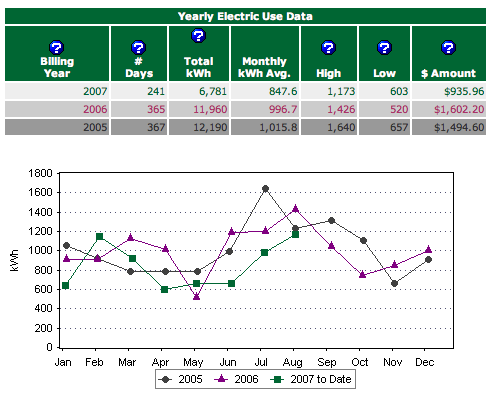
In fact, the letter adds that a proposed expansion of MGE's renewables program would reduce the clean power price premium to only one cent/KWh. [**] Fans of Jim Kunstler [***] might note that the issue with renewable energy is not price but the quantity that can be supplied. While cool breakthrough technologies such as cheap nanotech photovoltaics may help (maybe a lot), it shouldn't be forgotten that many electrons go to waste, with residential lighting, vampiric home electronics, and bottom-feeding office PCs among the notable offenders. Knocking 10% off of residential electricity demand won't save the world, for sure, but it (a) can't hurt and (b) is within the realm of the effectively free.
[*] This was partly via a no-cost reassignment of bedrooms, and partly via installation of a radiant heating system whose payback will be measured in utils, not dollars.
[**] To the possible objection that the one cent premium is subsidized, I note that the non-renewable power doesn't pay its external costs, given our coal-centric conventional generation.
[***] I'd count myself as one, though I don't agree with him all the time. (E.g.)
Labels: Energy, environmentalism, just life
Wednesday, June 27, 2007
The Eco-Friendly Hummer? Why Yes, I Am Kidding.
A "Dust to Dust" study of the life-cycle energy cost of cars by CNW Marketing Research has made a couple rounds of the intertubes, most recently following an update published this past spring. I caught wind of it by way of a commentary which ran in the Philadelphia Inquirer in April, authored by one James Martin of the 60 Plus Association [*], h/t to Autospies for the link,. Martin tells a horror story (debunked here) regarding pollution near the Sudbury Ontario smelter that supplies Toyota with the nickel that is eventually made into hybrid car batteries, then cites CNW's research for a claim that the life-cycle energy cost of a Prius is $3.25/mile, whereas the energy usage for a Hummer
Much of the negative reaction focused on the assumption that the Prius would be driven roughly 100,000 miles over its life, whereas the Hummer is assumed to have a 300,000-mile life. The latter figure, I'm sure, is far into the outer tail of the actual distribution of Hummer lifetimes, but that actually isn't CNW's biggest problem. The numerator of the energy cost-per-mile is off by a good order of magnitude, and almost nobody figured it out — not least CNW, who provide sufficient backup material to unearth the order-of-magnitude error and don't seem to realize it.
Economists should be instantly suspicious of a claim that the "cost of energy" for 109,000 miles of Prius driving (including the cost of recycling the Prius at the end) would be on the order of a third of a million dollars. (An Oregonian letter-writer and Mark of Denialism.com, among others, figured out that something was terribly wrong.) A ceiling for the energy's (expected) private cost — in fact, a cathedral ceiling in the MBR of a nice Toll Bros. McMansion — would usually be the price paid for the car plus the bills for fuel, maintenance, and insurance. This is because the various suppliers should pass their input costs on to the end consumer.
In the ballpark of CNW's assumed $3 cost per gallon of gasoline for the actual driving, that would work out to something like of $40,000-$50,000 over the 109,000 miles for a Nicely Equipped Prius. Much if not most of that reflects non-energy input — the metal in the car, mechanics' labor, etc. In fact, analyses showing that most of the life-cycle energy input is mostly in the driving (useful links here from the Union of Concerned Scientists' hybrid blog) would suggest that the energy cost is no more than around $15,000. So the actual private cost per mile is around 14 cents for the 109,000 miles.
CNW asserts that they are not trying to reflect only the pump price of gasoline, but the total social cost of the energy. Can that reasonably account for the differences? As a good liberal, I believe in the existence of substantial external costs of motoring as much as the next person, but I would suggest the answer is No Frackin' Way.
It's tough to put a price tag on those externalities, but let me throw out a figure of $2 trillion a year, worldwide, to cover national security expenditures, pollution controls, CO2 emissions offsets, etc., indirectly related to motoring. Clearly, this can pay for the portion of the worldwide military forces dedicated to securing oil supplies, the Bushist clusterf**k in the Middle East, and leave lots left over.
The $2 trillion is not accidental; it's also roughly the annual bill for worldwide oil demand at the present $65-70/bbl market price. [**] Whatever the real figure, note that there must be enormous external costs to escalate the 14 cent/mile private cost figure by a factor of two, let alone the factor of 20 CNW's Prius cost requires.
The error on the Hummer side of the equation is not as large, though still substantial. The Hummer's energy cost per mile is probably around 2-3 times the Prius's under a more usual accounting. The Hummer's much greater bulk is probably a bigger driver of its embodied costs than the Prius's more advanced materials mix, and on the road it consumes 3-4X the fuel per mile. So if the social cost of the Prius is 30 cents/mile, the Hummer works out in the range of 60 cents to $1/mile.
As I said, CNW could and should have found their error. An example of the information they had at hand is on p. 303 of the report, quoting a Google Answers document that cites a Ford study to the effect that a Taurus-type family sedan would have lifetime energy usage of 961 GJ. A parenthetical note added by CNW claims that the Taurus replacements (Fusion, Five Hundred) would have 1.53 times the energy cost thanks to being "significantly more complex" [***]. That factor is unsourced, but let's grant it: the Five Hundred's energy usage is 1470.33 GJ. How much energy is that, you might ask? The EIA says a gallon of gas has energy content of about 0.124 GJ (it's variable with the fuel blend). Thus, by advanced math, the Five Hundred-type vehicle uses the equivalent of 11,763 gallons of gas. At CNW's assumed $3/gallon cost, that would cost $35,288. Yet for the Mercury Montego (the Five Hundred's Mercury-brand twin), the cost-per-mile and assumed life work out to an energy cost of $344,128. This implies a cost of $29 per equivalent gallon of gas.
Inability to catch order of magnitude discrepancies in your own report does not inspire confidence. CNW's "Dust to Dust" results, in fact, appear to be nearly total bullsh*t.
Update 9/16/07: A rude anonymous commenter points out that the $1.95/mile figure applies to the Hummer H3, not the H2. This doesn't make any appreciable difference to the post, since the H3's fuel economy is 15 MPG city/20 highway by the 2007 EPA methodology, so even the relatively fuel-efficient H3 consumes 2-3x the energy per mile vs the Prius, and its 4,700-lb. curb weight implies higher embodied energy. It was disingenuous for James Martin to pluck the H3 figure out and call it the "Hummer" without a model qualifier; the H3 isn't exactly the "bete noire" of environmentalists in the sense of the CAFE-skirting H1 and H2. For the record, CNW's measured per-mile cost for the H1 was $3.51 and for the H2 was $3.03.
[*] A "nonpartisan" association devoted to the interests of the residuum of senior citizens who have not been made better off by the New Deal and Great Society retirement safety nets.
[**] Which is around 86 million barrels/day.
[***] From the excessive two-digit precision to the potentially mistaken assumption that greater complexity implies more embodied energy, there are lots of uncomplimentary things that could be said about this had I the time.
Labels: Economics, Energy, innumeracy, Trains Planes and Automobiles
Sunday, June 03, 2007
Could People Possibly Love Gasoline That Much?!
I'm catching up with blog stuff while I wait to get the last bit of the way home. Last weekend, Stephen Karlson found Lynne Kiesling reading patterns of gasoline consumption — not very sensitive to the late price swings — and concluding that people willingly give up consumption of Other Stuff to keep burning gas!
I commented:
[I]t strikes me that fairly obvious rigidities could lead to some confounding effects for both the own-price and substitution elasticities. And given that the high prices have been hitting truck sales pretty hard (esp. if you separate out sales of vehicles that are "car-based" but classified as trucks for regulatory purposes [*]), it seems that there is some voting-with-feet against being yoked quite so firmly to the gas pumps.Since I'm feeling surly, I'll add that resale values of gas-guzzling SUVs have been pathetic. Reveal that!
The obvious experiment would be to create a bike-ped-tram-train paradise like Vienna in the U.S., and *then* to see what people do when gas prices double...
[B]eing long in 1920's suburban -- now urban -- real estate, I'm partly betting that exurbia will be to the next few decades what rust belt cities' neighborhoods were to the latter half of the last century. At least for those who can get out.
[*] Which is to say, sales of less gas-guzzling "crossovers" are partly masking a collapse in truck-based SUV sales.
Labels: Economics, Energy, Housing Bubble
Friday, April 20, 2007
The Car and Energy Hog Societies: Nature or 'Nurture?'
(Maybe first in an occasional series.)
There's much to like about Jim Kunstler's takedown of Thomas Friedman's Sunday NYT article on the Brave New Green World. You could almost feel sorry for The Mustache. The article's overriding message that the world economy needs to green-up, and pronto, is certainly valuable — especially given the NYT's bizarre history of overplaying global warming skepticism.
Kunstler is dead-on that there's an underlying wrong-headedness to Friedman's piece that outweighs the positive messages, though, at least with regard to the implications for energy-related policies. Emblematic of this is Friedman's assurance that Americans will not need to "radically alter our lifestyles," and in particular his declaration that "We are who we are — including a car culture."
Inevitability and immutability arguments should be recognized as having little economic content. The factoid that the supposedly immutable often will give way to adverse price changes is part of the secret to the Big Bucks (or at least some fish-in-a-barrel shooting) for the econ profession. Marketing gurus such as Clotaire Rapaille may tell automaker clients that our lizard brains want to drive cars that are an M1A2 on the outside and the Drones Club on the inside, but come high gas prices and people buy Toyota Yarises anyway.
That Friedman's assertion is in exactly the next paragraph after a description of how our "culture" results from the combination of cheap oil and federal highway construction money (something Kunstler explicitly and frequently recognizes) just highlights the underlying economic emptiness. The cheap oil underpinning of the car culture seems to be on its way out; as the price tags soar for road construction projects that offer little real hope of untangling traffic snarls (see, e.g., Stephen Karlson here and here), policy makers and politicians might get a clue that there are higher-valued uses for the money.
This is just to say that durable infrastructure investments like suburbia may seem like they can't go away, but you need only turn to this article from Friedman's paper recounting the extent of the depopulation of the city of St. Louis (and lots of other mostly rust-belt cities) to see that ain't so.
Next: Our wacky views of transportation modes.
Labels: Economics, Energy, Journamalism, Trains Planes and Automobiles
Wednesday, March 07, 2007
Madison Landlords to City: Damn You for Your Negative-Cost Regulations!
Nobody should be surprised at Madison getting on the compact fluorescent (CFL) bandwagon. A little more surprising is the relatively mild form of the first proposed regulations. Following a suggestion from the Sierra Club, city council president Austin King has proposed a measure requiring CFLs in common area fixtures for older multiunit buildings as well as for suitable hard-wired fixtures within the buildings proper.
Reading the story in this morning's State Journal, I was waiting for the inevitable negative reaction from some local business association — the Chamber of Commerce or the like. Just what limb would one such an org amputate to avoid a dreaded mandate? I was not disappointed. The WSJ quoted Eileen Bruskewitz of the Madison
This is not something that needs to be regulated. This is the Progressive Dane approach to telling people how they should live.This is Totally Stupid. The simple economic Fact O' The Matter is that at current CFL prices, you can replace any incandescent bulb with a CFL, and in doing so you'd put money in your pocket: the CFL bulb returns far more than its price in energy savings. This is true, even, of expensive bulbs like the dimmable CFL floodlights we installed in our kitchen and family room. This is true even if you count the cost of properly recycling burnt-out bulbs. So Bruskewitz is actually asking the city council for leave for her association's members to piss money away. Bad, bad Progressive Dane for stopping them from doing so! As it happens, my former 8-unit apartment building, which I gathered to be of late-eighties or early-90s vintage (and thus probably subject to the proposed ordinance), used CFLs in common areas in the late-90s, when electricity prices were lower and CFL prices much higher, still for fairly obvious total-cost reasons.
Seconarily, Bruskewitz suggests that tenants might not want CFLs in their living spaces. This is a stupid argument, too. The illumination quality of modern CFLs is essentially indistinguishable from comparable incandescents. (That is, there are CFLs that have similar qualities to both soft-white and full-spectrum incandescents.) Plus, I'd be surprised if tenants would actually be willing to pay to replace a CFL with an incandescent bulb in a hardwired fixture.
The case of the CFL is, in my view, a signal failure of the H. economicus model. If people really could evaluate the full cost of lightbulb purchase decisions, the market for incandescents would have collapsed some time ago. Accordingly, I support regulations that would more-or-less ban the sale of incandescents. (I'd carve out an exception for low-wattage bulbs. Full disclosure: our front hallway fixture [in a 1930 house] is an antique that uses four 25-watt exposed-bulb incandescents. I judge such things to be insigificant in the grander scheme.)
Labels: Economics, Energy, Madison, Utter Stupidity
Tuesday, February 06, 2007
Global Warming Villainy: Is There Nothing to be Done About CO2-Spewing Jets?
After surviving the shock of Extreme Closeup Condi on the cover of this week's Time, I made my way to Bryan Walsh's "Greenhouse Airlines," which recounts some enviro-bashing of Prince Charles's air travel and comes around to offer this "well, duh" line:
On an individual level, a single long-haul flight can emit more carbon per passenger than months of SUV driving.A single long-haul flight carries a passenger a distance which, on the ground, would require months of driving.
The article cites an estimate that a round-trip flight from New York to Tokyo would lead to emissions of 5,200 pounds of "carbon" [sic, I assume Walsh means carbon dioxide]. But a New York-Tokyo roundtrip is roughly 22,000 km, or 13,600 miles. If you hypothetically drove the distance in an American car of middling fuel economy, you'd emit roughly 200 grams of CO2 per km of driving (*) — or 4400 kilograms (9680 pounds) for the trip. On a per-km-driven basis, the SUV driver isn't off the hook.
Needless to say, if a roundtrip to Tokyo took a couple weeks en route instead of a day, many of the passengers wouldn't make the trip in the first place. Those emissions result, in effect, from an interaction of the relative convenience of transonic air travel — encouraging actual presence in far-flung locations — and the "cheapness" to the air traveler of the greenhouse gas emissions.
Walsh states that the Intergovernmental Panel on Climate Change regards the growth of air travel as a relatively intractable problem lacking a "technofix."
As messy a source of pollution as electricity generation and ground transportation are, technologies do exist that could drastically cut carbon from power plants and cars. Not so for planes: the same aircraft models will almost certainly be flying on the same kerosene fuel for decades.Walsh continues
Nor is there any replacement for long-haul air travel itself. I can take a train from Boston to Washington, but until we can figure out how to travel via fireplace, Harry Potter--style, the only way I'm getting from Tokyo to New York City is in aircraft [that emits lots of greenhouse gases].This understates a variety of substitution possibilities. Declining costs of telepresence would tend to put pressure on business travelers to stay put (other things equal). We can go back to the future with more technofixable high-speed electric trains and airships. The main thing with the former is that it requires considerable advance planning and capital investment, since in my part of the carbon dioxide-spewing world, there is no intercity passenger train service of any sort worth mentioning. You see the latter crop up in science fiction here and there (e.g., Neal Stephenson's The Diamond Age), but whether or not we end up in solar-electric zeppelins, it bears noting that a lot of our supposedly indispensible airliner fleet could end up parked in the desert southwest along with many of their otherwise airworthy siblings consigned there for reason of fuel-diseconomy and/or excess supply of airliners given a suitable adverse turn of the oil market, a fresh round of security-related lunacy, or whatever.
In fact, my inclination would be to take on the long-haul travel last, since the capital investment/substitution fix is available for lots of short-haul air travel. There's the equivalent of a transoceanic flight or two's air mileage (**) flown daily between Madison, Minneapolis, Detroit and Chicago; thanks to security and air traffic control delays, those trips occur at speeds attainable by modern ground transportation — assuming someone has the foresight to make the intermodal links to long-haul flights at the big U.S. airports a la CDG.
-----------------------
(*) We'd previously found a figure of about 218 g/km for the E46 3-series (EPA mileage ~20 city/30 highway).
(**) There are lots of trips, but with small planes.
Labels: Economics, Energy, Global Warming, Trains Planes and Automobiles
Friday, February 02, 2007
The Other Answer is "ConAgra"
In response to the question, who gains from the much-discussed ethanol subsidy, here is one of the two answers:
Quarterly Profit a Record for Archer Daniels
Labels: Bushonomics, E85, Energy
Wednesday, January 31, 2007
Fuel Economy Follow-Up: Ah, Journamalism! (Never Trust Gregg Easterbrook Edition)
Kevin Drum reads Gregg Easterbrook ("Give Bush credit for his energy proposal") so that I almost don't have to:
Does 4 percent improvement per year sound too modest? According to the EPA, average actual fuel consumption of new vehicles sold in the United States is 21 miles per gallon. (The figure on the sticker in the showroom is often higher, but it is calculated under unrealistic conditions—no passengers or cargo in the car, air conditioner off, gentle acceleration, and no exceeding the speed limit.) Improve on 21 mpg by 4 percent annually for 10 years, and the number rises to 31 mpg. If the actual fuel economy of new vehicles were 31 mpg, oil-consumption trends would reverse—from more oil use to less. (Link omitted.)Were Easterbrook a journalist, he would have reported:
- Bush did not propose to increase fuel economy by 4 percent annually, but rather the fuel economy standards. (For the 2007 model year, those were 22.2 MPG for "trucks" and 27.5 MPG for "cars.")
- The Bush plan isn't for 10 years of annual increases. The fine print of the proposal calls for increases in the car standard from 2010 and in the truck standard from 2012 — seven and five years, by advanced mathematics.
- The truck delay reflects the phase-in of new truck fuel economy standards. Under those standards, for the first four years of Easterbrook's time frame, the truck standard would increase by 1.8 MPG by the EPA's reckoning. But the new rules actually cuts the standard for larger trucks relative to what is now known as "unreformed CAFE." (A primary motivation is to eliminate incentives to downsize such trucks, which is stupid for more reasons than I have time to consider this morning.)
- The WPE wants to do the same tricks for cars as trucks, which as I've previously noted can perform the regulatory miracle of making the standard appear to rise without requiring that vehicles actually increase fuel economy proportionally.
- Why Gregg Easterbrook would want to give George W. Bush a big sloppy kiss is left as an exercise for the reader.
Labels: Bushonomics, Economics, Energy, Journamalism
Monday, January 29, 2007
Read the Fine Print
Here's a minor addendum to Paul Krugman's "The Sum of All Ears" (non-Times Select excerpt at Economist's View). One road to perdition is that on which hulking SUVs run on E85 (85% ethanol, 15% gasoline blend) fuel in the name of greenness. When gas prices peaked last year, there were a few stories to the effect that the (subsidized) lower pump price of E85 was largely offset by increased fuel consumption owing to ethanol's lower energy density.
GM is helpfully, if in small print, showing the fuel economy of its flex-fuelable large SUVs on both gasoline and E85. The headline EPA mileage ratings for the flex-fuel GMC Yukon 4x4 SUV are 15 MPG city, 21 highway, which is bad but not terrible by the standards of large truck-based SUVs. However, a footnote indicates that the same vehicle gets a truly terrible 11 city/15 highway on E85. Given the biomass limitations of ethanol production under current methods, we could get in Big Trouble if people all thought they could burnish their green credentials while driving big trucks.
Now, the WPE admittedly did mention increasing fuel economy standards to get part of the way to reducing oil consumption -- the assumption is that passenger car standards would increase by about 7-8 MPG between 2010-2017, while truck standards would rise by 4-5 MPG between 2012-2017. While this appears to be a step in the right direction, this being the Bush administration, there must be a catch somewhere. And it turns out to be in a proposal to extend "attribute-based" standards from trucks to cars.
On the truck side, which we visited in 2005, this amouts to size-based categories that have the effect of raising standards a lot on small trucks (which are already relatively fuel efficient), less on midsize trucks, and not at all on larger vehicles. The effect is to get a rise in the overall standard while requiring relatively little improvement for any particular trucks. The initial proposal would have expanded the loopholes under which cars can be reclassified as trucks for fuel economy purposes, and would have created new incentives to re-engineer smaller vehicles to fall under the midsize truck standard. Mission accomplished!
Clearly, an attribute-based standard can easily do the same for cars, giving already-efficient subcompacts a higher-than-average standard (say, 44 MPG, vs. the 34-35 overall) while large sedans may see little increase or even a reduction in the applicable standard.
The proposal to create a separate set of attribute-based standards for cars actually begs the question of why you'd have separate car and truck standards in such a world. In effect, differences in the attribute mix of cars vs. trucks was part of the reason for separating them in the first place. With those attributes explicitly reflected in the standards, the effect is to give trucks a break (relative to cars) for their aerodynamical challenges.
Another significant issue is whether cars and trucks would be able to meet fuel economy standards using their performance on gasoline while subsidies and marketing efforts promote their operation at much lower fuel economy using high-ethanol-content fuel blends. This bait-and-switch would increase the farm-state pork content of the proposal.
Krugman snarks a bit about Cheney's disdain for energy conservation, and one thing I noticed was a funny expression on Cheney's face during the alternative energy part of the speech:

At that moment, Bush was describing the prospect for reductions in oil imports. While the picture might be worth a few hundred words, in all fairness Cheney might have been smirking in reaction to the orgasmic response that was pending from one member of the Republican Senate minority:

Labels: Bushonomics, Energy, Regulation