Thursday, July 23, 2009
Gresham's Law of Pizza Relaxing?
One of those signs of a possible bottom of the Great Recession is that compared to (say) 9 months ago, a lot less of the time I spend worrying about the possible demise of beloved local small businesses is spent worrying about the one I work for.
Tops on the list of the hope-they're-thriving list is Pizza Brutta, our neighborhood outpost of the Madison Pizza Renaissance. Time was the city's pizza problem was that there was a lot of mediocre-to-bad pizza serving the large and quality-indifferent student and suburbanite-takeout markets. OK, there's still a lot of mediocre-to-bad pizza around. But with a Pizza Brutta around, making pies in the authentic Neapolitan style (with VPN certification) with market ingredients, the rest of them can be ignored.
I have a hard time imagining their cost structure. The big "fixed" investment is the wood-fired pizza oven. Was the build-out cheap or expensive? What are rents like on that stretch of Monroe St.? What's the margin on the microbrews on tap?
We recently hauled Nina Camic and the kids there for a one-of-us-is-still-blogging dinner.
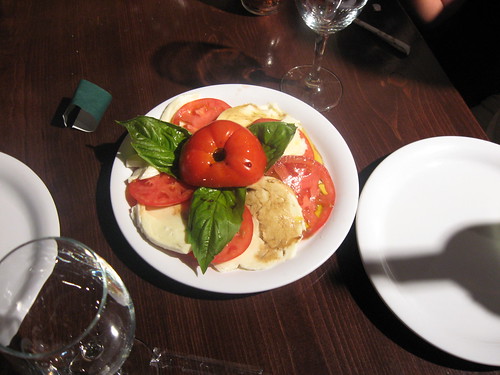
The Caprese salad, with tomatoes from the Westside Community Market and house-made mozzarela:
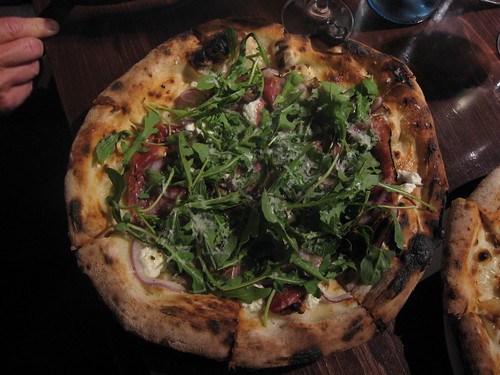
The Caprino pizza (prosciutto, mushrooms, red onions, goat cheese, and arugula):
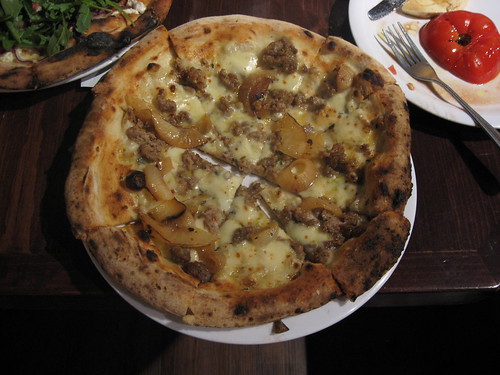
The Salsiccia pizza, my regular (house-made sausage, roasted onions, truffle oil):
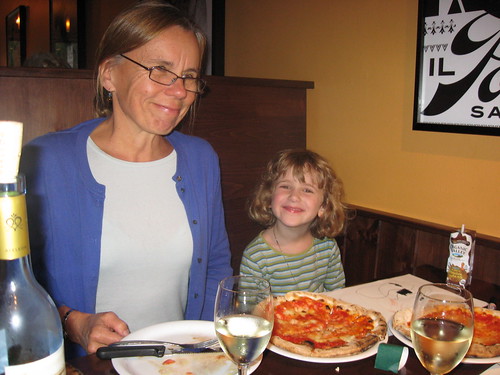
Nina and Julia:
For some lily-gilding, Cafe Porta Alba, another VPN outlet late of downtown, is reappearing at Hilldale Mall while the Pizza Hut across the street appears to have closed. Madison readers, support good pizza!
Labels: Madison, Vera Pizza Napoletana


Monday, December 15, 2008
Big Fraud in Little Madison
Earlier in the year I reviewed the investments held by the Madison Cultural Arts District's trust fund, which once had been intended to use stock market returns (and later alternative investment returns) to pay the Overture Center's construction debt and contribute to the Center's operations. I concluded that the fund was undercapitalized and needed to get cracking on fundraising. In September, the fund reached a point where it was to be liquidated to pay off the bulk of the construction debt, leaving the major donor and the city of Madison on the hook for the balance. We only recently, as lapsed Madison Symphony subscribers, received a fundraising letter.
An interesting detail is that when I'd reviewed the MCAD trust's assets, it held $17.9 million — just under 18 percent of its $100M portfolio of the time, in the Fairfield Sentry fund. (In early '06, they had an even greater exposure.) At the time, Fairfield Sentry was among the trust's high-flying investments, relatively speaking. I said "who knows" with respect to how Fairfield found its alpha.
Well now we know! Per Bloomberg (via), Fairfield Sentry was 100% invested in Bernard Madoff's mega-swindle! I hope they actually managed to liquidate their balance. If they did get out soon enough, then at least the MCAD trust may not have been the biggest of suckers in one respect.
Otherwise, big potential losers are Andrew Ang, Matthew Rhodes-Kropf, and Rui Zhao, whose April '08 NBER working paper concluded that funds-of-funds "on average, deserve their fees-on-fees." At a minimum, they should delete the Madoff suckers and recalculate.
Labels: hedge funds, High Finance, Madison
Thursday, May 01, 2008
Dep't of Bad Metrics
Mike Ivey reports in the Capital e-Times that Madison homeowners rank high for house-poverty:
The city was ranked No. 10 in a survey of places with the highest concentration of homeowner debt because of home equity loans or second mortgages. It said 27 percent of homeowners here have a second mortgage or home equity line of credit.
Sacramento, San Diego, Washington, D.C., and Colorado Springs were ranked as the four markets with the highest debt load. Denver, Minneapolis, Los Angeles, Boise [?!], Las Vegas and Madison rounded out the top 10...
The survey was based on U.S. Census data to determine which of the country's largest 150 housing markets had the highest percentage of outstanding home equity and second loans. Forbes combined that data with housing price trends from the National Association of Realtors, to gauge which markets are experiencing steep price drops.
You'd have to wonder about a ranking that puts Minneapolis and Boise ahead of Vegas on the stress-o-meter. Other statistics aren't so dire. Also via Ivey, who has an excellent long piece on stalled residential construction projects in the area:
That 1-in-2600 foreclosure rate is a considerable increase over pre-crash rates, but the level is a bit more like it. The Madison metropolitan area as a whole never saw the sort of house-price inflation (I should update this graph) that dangled hundreds of thousands of dollars of ephemeral equity in the faces of Joe and Jane Homeowner, in contrast to the Irvine Housing Blog's tales from Real Estate Hell. Which is not to say that I'd want to have to sell my house anytime soon.At the same time, the Madison area housing market has held up better than a lot of places. In Nevada, for example, nearly one in 140 households was facing a mortgage foreclosure last month. In Dane County, the figure was just one in 2,598, according to RealtyTrac.
Anyway, the mere presence of home equity loans and/or HELOCs doesn't say a whole lot. They're a source of relatively cheap credit, and if you have to borrow money, cheap is good. You'd never say that a HELOC borrower was more stressed than an otherwise identical borrower who had the HELOC debt on credit cards. As with many tools, they're dangerous when misused — and, moreover, widely were — but Forbes seems here to have gone for the data that was around rather than data that were directly on-point.
Labels: Housing Bubble, Madison
Friday, April 18, 2008
Welcome Isthmus Readers
Here's Overture Center Finances: A Fine Mess.
Everyone else, here's Tom Laskin's The Overture Center: Coming up short, reviewing the financial crisis at Madison's arts facility.
Labels: Madison
Monday, April 14, 2008
Not A Good Sign for High-End Housing
Most of Madison was never especially bubbly, but the Big Shitpile has a way of getting under one's shoes:
So no high-end housing market recovery until at least the fall. Now that buyers of $10,000 fridges demonstrably are not recession-proof, we may need to look to mega-yacht cancellations for more bearish news.Sub-Zero/Wolf of Fitchburg, a manufacturer of high-end refrigeration and cooking appliances, will lay off 235 employees at its plants in Fitchburg and Phoenix, Ariz..."It's no secret what's going on in the economy and what's happening with consumer confidence," [Chuck Verri, VP of HR] said. "We're building inventories too rapidly and we've got to do something to react."
Verri said employees were notified Monday and will lose their jobs on or after June 13.
He said the slowdown in construction of high-end homes and condominiums is a major factor in the layoffs.
Labels: Housing Bubble, Madison
Friday, April 11, 2008
Overture Center Finances: A Fine Mess
Quick background: The Overture Center, Madison's $205 million concert hall and arts center, was a gift from local philanthropist Jerry Frautschi (who made his fortune investing in American Girl, founded by his wife and sold for big $$ to Mattel). The gift was structured so that about half was put in a trust fund, intended to pay off construction debt and contribute to the Center's maintenance, assuming it made roughly 9% annual returns off stock market investments. The year was 1999. D'ohh!
After years of 2% annual returns, the trust fund represented insufficient collateral for the bankers, so a refinancing plan was hatched, and approved in late 2005, that required the City of Madison to guarantee a portion of the debt. The plan would work just great as long as it attained an 8.25% annual average return and the trust balance stayed over $104 million. That also hasn't worked out so well, as noted here a week-and-a-half ago.
My question has been, how have the Overture trust fund's managers managed to screw up so badly? Well, other than the obvious reason that 8.25% is well above any sane person's idea of a risk-free return. Courtesy of Isthmus executive editor Marc Eisen, I've seen a spreadsheet with a summary of the Overture trust's investments, and can only conclude that the investment choices never gave them a serious chance. For junkies of mid-sized institutional asset management stories, some gruesome details are after the jump.
I'd divide the trust fund's management into two eras, the Cash Era and the Alternative Investments Era.
The Cash Era ran from late 2005 to late 2006. The trust fund's balance ranged from $106.2 million to $109.3 million over the period, and 46% to 61% of that was held in "cash equivalents." The balance was in "general equities" (which I take to be meant generically, and not the firm General Equities) and Fairfield Sentry Ltd., a hedge fund. The higher cash percentage was sustained for the latter two-thirds of the year, when the trust turned a good portion of its Fairfield Sentry holdings into cash equivalents. My naive calculation from the spreasheet says that the equitites returned 4.6% and the Fairfield Sentry fund returned 8%. In 2006, you could have made right around 5% with a very good money market fund, such as the institutional share class for Vanguard's Prime Money Market fund. The upshot was that their weighted average return was right around 5% for the year. With that asset weighting, the trust had to make 12.7% off the non-cash-equivalent assets to reach the 8.25% target. 2006 actually was a good year for stocks — Vanguard's Total Stock Market index fund returned north of 15%. They chose a bad year not to be 'seeking beta.'
The interesting question is why they stayed in cash for so long post-refinancing. Pardon me for thinking that the financial geniuses behind the refinancing might have had an investment plan ready to roll upon approval. None of the obvious answers — they didn't have a plan, the Cash Era represents an inept plan, and they chose a deliberately defensive position to avoid the political embarrassment of a quick I-told-you-so from refinancing opponents — is confidence-inspiring.
The Cash Era ended in late-2006, as the cash-equivalents gradually moved into a series of other investments. At the end of the series I've seen (3/14/08), only 2% of the Overture trust is held in cash equivalents. I call this the Alternative Investment era as it was kicked off with a roughly $15M investment in "Highbridge Fund," which appears from the value of holdings to be the quasi-hedgey Highbridge Statistical Market Neutral fund (as of 3/14, 21% of the fund's holdings). Stakes in Pimco All Asset fund (a fund of Pimco funds, 16%), principal protected notes (PPNs) from JPMorgan and Barclay's (the latter purchased with the proceeds of the "general equities,"14% and 8%, respectively), additional investment in Fairfield Sentry (18%), and "JPMorgan muni's" (20%) followed.
It's hard to reliably track performance across the board because of apparent asset sales and purchases, but nothing has come especially close to putting in an 8.25% return over the period. The highest-flyers, the Fairfield and Pimco funds, have had 1-year returns around 6%. The Highbridge 1-year return was 1.2% (they've done relatively well YTD), the munis are up 2% over the 7-month period they've been held, and the PPNs down. The upshot is that the trust is showing a weighted average return around 3% for the last year, far below the target. Granted, all I need to do is look at my 401(k) performance to see that it's been a tough year through the end of March — I'm down 3.3%, though then again my five-year average is 9.7%. An irony is that while Madison Cultural Arts District Treasurer told the Cap Times that it would be "a very unfortunate change" if the creditors forced the assets into Treasury securities, which might be true now, had they actually been in Treasurys all along, they'd have ridden the bond market's flight to quality well past their return goal for the past year. Whatever the skills of the MCAD, investment timing ain't it.
The better question, perhaps, is what the prospects would be for this asset mix to earn 8.25% on average in the future. The underlying assets for the PPNs could be anything, so it's hard to say there. The munis won't under foreseeable interest rate environments. Pimco All Asset seems to be tuned to produce single-digit annual returns. Highbridge hasn't exactly been minting 'alpha,' and who knows about Fairfield Sentry. If the PPN investments were selected at least for perceived safety before the fact (actual performance notwithstanding), then I'd have to say it isn't going to happen. If nothing else, the MCAD seems to have done a good job of picking relatively high-cost holdings, which just increases the return that has to be earned from the underlying assets for the trust to net 8.25%.
This brings me back to my main point — the MCAD is undercapitalized, and they should get cracking on raising money. That was something that was supposed to have been facilitated by keeping the facility in the hands of the MCAD instead of under direct city ownership, but a capital campaign seems to have become a priority only now that they're in the soup. If they want to make good on the facility's promises, and shut us critics of their financing misadventures up, they need to raise a lot.
Return to the Marginal Utility main page.
Labels: hedge funds, High Finance, Madison
Tuesday, April 01, 2008
Some Reality Reaches Our 70 Square Miles
1. Hilldale Phase 2 delayed (again), a little sign of the CRE bust?
Barry Adams's State Journal lede blames the "harsh winter and changes to the design" for a delay in the start of construction at the seven-acre moonscape across from the office until July. This would house a greatly expanded Whole Foods, provide 3 floors of office space, and a 140-room hotel. When last we heard from Jos. Freed & Co., just a month ago, the harsh winter, the phase was supposed to be completed by spring to summer '09; it's now fall '09 to early '10.
I'd figured that Whole Foods would keep the project more-or-less on track, especially seeing as there's reportedly a tenant interested in a full floor of the office building. Oh well.
This project had been an example of the condo bust's losses looking like CRE's gains, at least for a while; the hotel replaced one proposed condo tower, and another mixed-use building (3 floors of office, eight of condos) was scaled back to a 5-story office building, since reduced to 3. Next stop, the soccer fields at Hilldale Phase 2?
2. Big Sh*tpile in Little Madison Revisited, Overture trust balance reaches new lows.
Who could have predicted that 8.25% annual returns aren't risk-free? Well, Mayor Dave Cieslewicz, of course, and the editorial pages of both papers.
The geniuses who manage the trust's investments have managed to turn $109.3M in December '05 to $100.1M as of March 14; they needed to maintain $104 million to make the 2005 refinancing work as advertised, with the trust paying the construction debt and making a contribution to the Overture Center's maintenance.
The problem has been pretty simple all along: too little money required to do too much stuff, so the plan has depended on generating returns sufficiently large that they can't be counted on all the time. As it turns out, you can be too generous and too cheap. The original assumption was a 9% annual return (in 1999, when it was assumed it would be generated from stock market holdings), and the times being what they are, they got 2% through 2005. The refinancing plan shaved off 75 bp, but was especially sensitive to low realized returns in the early years (oops).
Something I wonder is why a nonprofit endowment like this can't buy into a better class of money management. Some of you have surely seen that the peer group for Jane Mendillo, the Wellesley investment manager recently hired to helm the management of Harvard's endowment, turned in a 13.9% 5-year annual average return to the middle of last year. (I'm curious to see what the last nine months have done to the high-flying endowments.) The Overture fund isn't in this size class, but nevertheless I wonder how its management does so poorly? And why can't they just buy into the competent management of larger endowments (i.e., are there tax or regulatory obstacles to doing so)?
The solution, of course, is to raise more capital for the fund — something that was advertised as being facilitated by retaining quasi-private ownership of the facility, but which has yet to materialize except, perhaps, by way of a bailout to prevent a chorus of I-told-you-sos.
Labels: High Finance, Housing Bubble, Madison
Wednesday, February 20, 2008
Mr. Popularity
Based on the 2004 Wisconsin primary results, when the neighbors cast more votes for Dean and Kucinich (together) than John Kerry, I'd wondered if McCain would come in behind Edwards or some other recently-withdrawn Democrat. As it turns out, there were only 20 votes for Democrats other than Obama and Clinton in our ward (Madison ward 66), and McCain got 47. So with a theoretically contested Republican primary, McCain got fewer votes than George W. Bush running uncontested in the non-event '04. Well, Republican turnout was up a bit over '04, with 79 total votes cast.
McCain's victory speech was simply awful, in a delightful way, for its Reverse Mary Poppins framing of his candidacy: the stern granddad who'll administer the spoonful of medicine so that nobody goes around getting too hopeful. While the one gauzy McCain ad I'd caught before the election showed him strolling with Ronald Reagan, he's positioning himself more as a Republican Walter Mondale. Malaise forever! [*]
On the Democratic side, Obama's margin was wider than I'd expected, 890 to 270. Barkley Rosser was right about Dane County, which overall went for Obama 67%-31%. Now, Dane County's Deaniac, Edwardsite, and Kucinichian majority ended up uniting behind Kerry and then some in the general election, helping to overcome strong Republican turnout for Bush and make Kerry's margin a little less slim than Gore's. But I think Paul Soglin's right that Obama would not be as dependent on rolling up a huge margin in Dane County to offset our wingnutty neighbors to the east, and I doubt the Democratic nominee won't need our electoral votes.
[*] Which is unfair to Mondale, I know.
Tuesday, February 19, 2008
Cold Day Ending
Ken's series of posts notwithstanding, I voted for Obama this evening. Just before 5:30, I put the 881st accepted ballot in the reader, suggesting that by 8:00 there would be a fair number more votes cast than the 1125 in the 2004 primary. My reasons are old-fashioned: I like his proposed policies on balance a little better than Clinton's, and I think he's run a much better campaign so far.
There's no question that the Republicans will send out the hounds regardless of who gets the nomination, but Obama's 50-state campaign shrewdly attacks a McCain candidacy at its areas of putative strength — appeal to independents and pan-partisan moderates — which is really non-evil Rovianism. Early indications are that Obama would force McCain to contest previously safe states like Virginia when the Republicans have dissipated tens of millions of dollars on candidates who can barely get their trophy wives to vote for them.
Much of the Obama backlash is risible. The meme that he's the candidate of pretty words and no substance doesn't hold water given the broad array of issues for which he's established more-or-less detailed positions. Others may, of course, think otherwise, but David Brooks's "the candidate's a lib—" column in today's NYT ought to be proof enough that I'm at least getting the solidly left-of-center-left candidate I think I am.
That's not to say that there's anything wrong with promoting hope. We got into this mess, in no small part, by forces that played first on apathy (it doesn't matter whether you vote for Bush or Gore; they're sides of the same coin) and later fear ('Don't Change Horsemen in Mid-Apocalypse'). And one thing was for sure at the polling place, there were a lot of young people registering to vote for the first time. Bryan Caplan might deplore the extension of the franchise to non-believers in Caplanism, and maybe some of those kids will cast votes that I wouldn't. But I'd have to think that it's harder to assemble 51% of the electorate for preservation of the current corporatist oligarchy the more people actually have their say.
Labels: Madison, ObamaNation, Politics
New Day Rising?
Election morning here is kicking off with signs that there is a powerful light source in the sky, so I imagine preparations for a high turnout won't be in vain. A few well-bundled peds have already made their way to the polling place, where Suzanne will be manning the kids' preschool's bake sale table shortly.
Over here in the 66th ward [warning: large PDF map], the second most interesting question is whether John McCain will outpoll the Democrats who've dropped out of the race. (Results for Dane County will be posted here.) In '04, like Dane County, we broke narrowly for Kerry — 341 votes to 309 for Edwards — and even Dean (270) and Kucinich (123) considerably outpolled George W. Bush, who picked up 56 votes amid light turnout for the uncontested Republican contest. And we aren't the most liberal ward in the city by a long shot.
Polling of the race suggests that Obama will roll up a double-digit margin over HRC, and that's
consistent both with the chatter over snow-shoveling and the open primary format.
Added: Suzanne was voter #225 just after 9 A.M., so turnout is brisk but the short ballot is keeping the line short.
Monday, February 11, 2008
We're #1, Please Kill Me Now
Some climate data as of 2/11/07...
| City | Snowfall (in.) since July 1, 2007 | Heating degree days (F) since July 1, 2007 |
|---|---|---|
| Wilmington, DE | 6.9 | 2,694 |
| Binghamton, NY | 44.1 | 3,935 |
| Syracuse, NY | 71.0 | 3,718 |
| Madison, WI | 75.5 | 4,550 |
You have that right, folks, despite being relatively free of lake-effect snow by virtue of geography and prevailing winds, we are snowier than Syracuse for the winter-to-date, with another 3-4" expected tonight. Looking around, I have to head to the Lake Superior snowbelt to find someplace materially snowier.
It perhaps goes without saying that if I wanted to live in Syracuse, I could have had twice the house for half the price, access to the Stickley factory outlet, etc.
(Note to Mom: pack boots.)
Tuesday, December 11, 2007
Meanwhile in Happy Real Estate News
I've heard that a third major condo project in the city has bitten the dust — the residential component of the Heights at Hilldale. Apparently the building, originally to have had three floors of office space and 8-9 of condominiums, will scale back to five stories of offices. Purchasers of certain views at the neighboring — and still quite empty — Weston Place condo may be pleased. If confirmed, the Heights condos would join the Centric Metro Lofts, also part of the Hilldale redevelopment at one point (to be an upscale hotel) and a building in the Capitol West development (ditto) in Big Shitpile oblivion [*].
This is something of a shame, since the University-Midvale corner is shaping up as a good walkable area with solid bike and transit connections to campus and downtown Madison. But there are enough potential infill sites in the vicinity to make up for it later as market conditions permit.
[*] I don't count the Camp Randall-area Fieldhouse Station proposal, since intense opposition from the neighborhoods and their Alderoids gave the project zero chance of approval.
Labels: Housing Bubble, Madison
Expletive Deleted
...THE MADISON CLIMATE SUMMARY FOR DECEMBER 11 2007...
CLIMATE NORMAL PERIOD 1971 TO 2000
CLIMATE RECORD PERIOD 1871 TO 2007
SNOWFALL (IN)
YESTERDAY 5.1 [Record] 5.3 1904 [Normal] 0.4 [Departure from normal] 4.7
SINCE DEC 1 21.1 [Normal] 3.8 [Departure from normal] 17.3 [Last year] 2.6
SNOW DEPTH 12
Labels: Madison
Thursday, December 06, 2007
Dep't of Just Wondering: Big Sh*tpile in Little Madison?
The story so far...
Rich Guy invests in wife's toy business. Wife sells business to Mattel, making Rich Guy a Super-Rich Guy. Now-Super-Rich Guy donates $205 million to turn Madison's dowdy Civic Center into the Overture Center.
Super-Rich Guy establishes financing scheme that purports to be able to pay for the Overture Center's construction and contribute significantly towards its operation and maintenance even though the construction tab is approximately $205 million. An assumption is that the trust will earn 9% average annual returns from stock market investments. The year is 1999 — oops.
In late 2005, the Overture Center's construction debt is refinanced in a controversial deal that involved the City of Madison guaranteeing a portion of the debt and possibly being on the hook for Center maintenance should the fund's balance fall below $104 million. (It was $109.3 million as of the refinancing.) The expectations for the fund's returns are shaved by 0.75% and the investment strategery is meant to emphasize "diversified investments that limit short-term volatility."
At the time, we were not impressed:
Now, I couldn't tell you whether the Overture trust will clear its rate-of-return hurdle even if I knew the details of its investments. As was seen in the Social Security privatization battle, predicting forward-looking returns is unavoidably contentious, and even if you could reliably predict expected returns, the realized returns' deviations from expectations matter — as Mayor Cieslewicz and the council's fiscal hawks emphasized. (And, echoing a point I made yesterday, he had stressed results from the city's fiscal efficiency auditor that the city bears especially large risks from poor near-term returns.)
What's basically incontrovertible is that the trust is undercapitalized. I'm inclined to agree with David White of AFSCME, who according to the Cap Times:Reject[ed] claims that it would be easier to raise money for the facility if it were not part of the city as nothing more than "a talking point," White also said he did not trust markets in the next few years to deliver returns consistently above 8 percent.Assuming the plan goes forward, the ball is in the foundation's court to put some action behind the assertion that the existing structure can do more for Overture than city ownership, raise some money, and thereby reduce the taxpayer's risk the old fashioned way.
So how did they do with that short-term volatility? Here's the Wisconsin State Journal account from early October, via Emily Mills:
The trust, which must be at least $104 million to meet all commitments, sank from $105.83 million on July 13 to $100.86 million on Aug. 15, doubling any prior decline and nearly forcing the district to tap other sources to meet debt payments.Some timing, there. Looks like the Overture Foundation got into Big Shitpile with the impeccable timing for which it is becoming best-known. The question is, what's happened to the trust in the last few weeks?
The fund recovered to $103.31 million -- still below the $104 million mark -- by Sept. 28, according to the latest report by Madison comptroller Dean Brasser. The trust has since added another $400,000, the Overture Foundation said. [Emphasis added.]
Labels: High Finance, Madison
Tuesday, November 06, 2007
Dispatch from the Island of Lost Posts: College Town Triumphalism Edition
Not surprisingly, yesterday's Wisconsin State journal ran (A1, above fold) Ford Fessenden's NYT article listing college towns including Madison and Ithaca among the metropolitan areas least exposed to subprime lending. The theory advanced by Bruce Katz of Brookings sounds more-or-less right to me:
“Those housing markets are not superheated... And salaries are pretty good for faculty and research assistants [i.e., staff, not graduate student RAs]. So wages and housing prices are more in sync than in the rest of the country.”Certainly, the UW and the state government provides plenty of middle-to-upper-middle class employment; Madison has relatively little in the way of old money and the super-rich. It's also an example of a limitation of the OFHEO house price indexes. Rapid sprawl has helped hold down prices in the postwar suburbia, much of which has seen little or no appreciation in the Case-Shiller sense; while some central neighborhoods boomed enough to price us out of them, older neighborhoods have gone from being priced well below replacement cost to mildly below, and remain affordable relative to the New Urbanism developments in the 'burbs.
Needless to say, the real estate-industrial complex would like to pathologize the situation. In late September, Stephen Elbow of the Capital Times (our usually progressive afternoon paper) wrote a lengthy and seemingly unironic article on the rapid growth of seven-figure housing in the area. In the hitherto unposted "Luxury Housing: The Rich Spend Drunken Sailors Under the Table," I'd written:
The article has two main lessons for the careful reader.
First, exurban McMansions are terrible investments. We're regaled with the story of investor Wayne Sweeney and his 5,700-sf house in the Town of Middleton, for which he reportedly paid $1 million nine years ago. Elbow writes:When it was built, Sweeney's home was assessed at $880,000. Now it's assessed at the $1 million he paid for it, but on the open market it's likely to fetch more. Both the investor and the homeowner in him are pleased.If Sweeney wants to spend a lot of money on a big house and hire Blackwater Lawn Care to fight World War V against 1.5 acres of potential weeds, then for the most part that's his funeral. [*] But as an investment, the house is not so good. A gander at the top end of the Town of Middleton listings suggests "more" might be $1.2 million or so on a good day. Subtract $72,000 in commissions and whatever Sweeney has spent to improve and maintain the place [**], and you have something like $1 million. In contrast, you could have turned the same $1 million into 1.26 million in (federal) tax-free money market investments, picked up another $250,000 (after tax) in the stock market even weathering the bust, and who knows what in alternative investments.
But wait, what about the the taxes?At the city mill rate, 2006 taxes on a house assessed at $1 million would have been $19,700 — more than the Middleton taxes, for sure, but far less than twice as much, unless of course the Madison location made the house worth more. It's impossible to tell from the story exactly what Sweeney's net investment is, but late-90s Madison prices were such that it's likely a mid six figure amount, which would pay the difference in city taxes forever, or nearly so.And being inveterately cash-conscious, he doesn't miss the taxes he paid on his last three homes on Madison's near west side.
"The taxes here are great," he says.
In 2006 he paid just over $13,000 in taxes, and he estimates he would pay more than twice that if the same house was in Madison.
Moreover, Sweeney bailed out of the very Madison neighborhoods that exhibited the greatest bubble-like appreciation before the run-up in prices really got underway.
As for the tendencies that keep many Madisonians less house-poor:Then it gets personal:[Builder Hart] DeNoble says the relatively recent boom in luxury housing was overdue, stalled in part by an innate stinginess among Madisonians when it comes to housing.
"People in Madison tend to spend not as much of their income on housing as a lot of other parts of the country," he says. "And I'm not just talking the coasts."He reels off a string of cities -- Minneapolis, Chicago, St. Louis, Cleveland -- from which some of his past customers have moved and been stunned at the area's low housing costs.
Cleveland and St. Louis? Ouch. But is it me or does this smack of Lyle Lanley and the monorail?
"I had a customer from Cincinnati and she said, 'I can't find anything on the market that we like. There's hardly any homes in our price range,'" he says. "They wanted to spend $1 million."
Unfortunately, fewer customers seem to want to do that these days. Elbow reported that Town of Middleton residential starts have plummeted from a peak around 100 "a few years ago" to 31 in 2006 and 11 in 2007 through the September publication of the story.
Now cue the class warfare!
Those darn mid-career professors, doctors, and lawyers, always ruining things for everyone else.For such customers, the town of Middleton has become a safe haven where property values are protected from the corrosive effects of more moderately priced housing.
"I think customers are smart enough to know that if everything else in the neighborhood is $550,000 to $650,000, you don't want to put a million in your house because when it comes time for resale you're never going to get it," he says. "The neighborhood will I don't want to say drag you down, but it will."
[*] It could be objected, and indeed I do object, that suburban development is underpriced and hence over-provided.
[**] Rules of thumb suggest a couple percent of the house price per year, which hasn't been wildly off in my experience with much less expensive houses.
Labels: Housing Bubble, Madison
Friday, September 21, 2007
Around the World and Elsewhere
I have a post up at Total Drek on our own Freedom From Religion Foundation's efforts to keep (not necessarily religious) advertising out of Madison schoolkids' backpacks.
Labels: free riders, Madison, Religion
Tuesday, July 31, 2007
Dep't of Ouch
Some friends of ours from the Old Neighborhood Play Group had the distinction of being among Those People who brought early-bubble-period big city sales proceeds into the Madison market and thus helped price us out of certain neighborhoods. (Not that we're looking back; we love our now not-so-"new" house and neighbors.)
Putting our friends' many other virtues aside, I'd thought of them as having been fleeced thoroughly in the purchase of their house in the old 'hood. Since they recently moved to a larger house in Madison's '70s suburbia, I just got a chance to test my view over at the city assessor's website. It was confirmed. They bought in May 2003 for X. They sold in July 2007 for 0.945X. Their house was conventionally listed, so they probably paid 6% in commissions to real estate agents on the sale. Thus, net proceeds from the sale were about $48,000 less than the 5/03 purchase price. Solving for X is left as an exercise.
Some of you may consider X to be rounding error in prices in your home markets, but it's real money here in the upper-Midwest. OTOH, if you think X sounds like a lot of money relative to the price of houses in your area's nice older neighborhoods, then there's a decent chance the bubble never inflated in your area, in which case you may not need a hard hat so much as a parachute should a full-fledged credit crunch develop.
It's just one data point, for sure, but it goes to show that market softness isn't limited to condo flippers. Houses may be "fungible," but transaction costs are substantial and will wipe out gains in flat markets. And if you think that prices are now looking swell, caveat emptor!
Labels: Housing Bubble, Madison
Sunday, July 29, 2007
Sunday Preschooler Extra: Butterflies!
Regarding the Blooming Butterflies extravaganza at local treasure Olbrich Botanical Gardens, Madison Guy says, "Be sure to bring a camera. You can't miss." It's true!

The kids did get into some butterfly-related program activities, though we thought it was pretty odd that this board makes it look like the Very Hungry Caterpillar is after Julia.

A few more pictures after the jump, or head on over to Flickr for even more.
Two sides of a Peruvian butterfly, still iridescent after 81 years:

Ready for takeoff:

Zebra stripes:

On the Great Ice Cream Hunt (collect stamps in the outdoor gardens, get a cone of Michael's Frozen Custard):

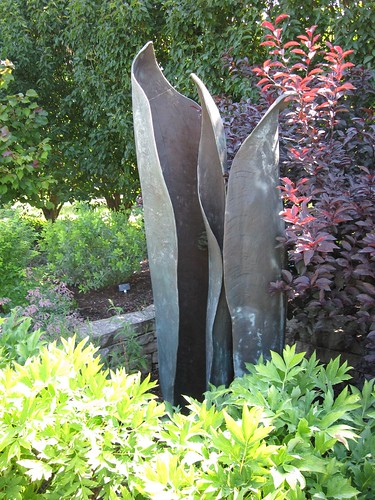
Sylvia Beckman's bronze "Spring," now surrounded by peak summer vegetation:
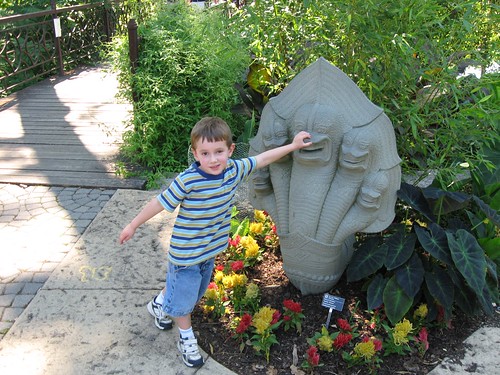
The "look only with your eyes" message didn't quite stick (monster at the bridge to the Thai Garden):
Butterfly bush, minus the butterflies:

Post-butterfly treat — less of this was worn than you might think:

Back to the Marginal Utility main page.
Friday, July 27, 2007
Random Bullets of A Grand Evening Out

We've heard Overture Hall's concert organ (shown, in part, above) in a supporting role with the Madison Symphony, but I was curious to hear it front and center, and got my wish with a recital by the Cathedral of Notre Dame organist Olivier Latry last night, at $15 a super-duper bargain. Some thoughts:
- The hall and organ are gifts of local super-rich people Jerome Frautschi and Pleasant Rowland. She made her fortune with the upscale and pricey American Girl dolls (esp. selling the line to Mattel). He invested in his wife's business. They deserve much credit for holding the line on the corporatization of public buildings, and not giving Madison an American Girl Hall, or even the American Girl Organ at Overture Hall. The program had noted that Latry recently christened the organ at Philadelphia's Verizon Hall.
- Attendance was good. Why no refreshments at intermission? (There were Issues with the implosion of the firm that had the concession, but that really should have been ironed out.)
- One point from the introduction of the artist was that Latry spends about 250 nights a year on the road. That did a lot to suspend my usual thoughts that it would be really cool to be a top-tier touring musician.
- Latry's dismount from the organ bench was so jaunty it did not fail to put a smile on my face. I suppose successful concert organists must work on that.
- For my money, the most impressive feat of musicianship, not to mention coordination, was a "Trio" movement from Balbastre's Livre d'orgue de Dijon. It made my brain hurt just thinking about trying to have my right hand, left hand, and feet engaged simultaneously at independent tasks.
- Latry was also reported in the program to have recorded the organ works of Messiaen, which would have been more interesting to hear from than some of the works on the program, but I'm not sure if it wouldn't have set the audience fleeing.
- The program seemed pretty secular as the organ repertoire goes, actually. It was, at times, very loud — even to my slightly rock-n-roll damaged hearing — but maybe not so much to attendees past the seemingly rather advanced median age of the crowd.
- One of Latry's claims to fame is as an improvisateur. Among three themes he was tasked to improvise on at the end of the concert was a bit of "America the Beautiful" (through "amber waves of grain." The resulting improvisation evoked the Nautilus at flank speed, getting ready to send some unsuspecting man-o'-war to the bottom. A message, perhaps?
- The encore, an improvisation on the chimes of Big Ben [MP3], didn't seem to be quite so loaded.
Labels: Madison, Music, Random Bullets
Friday, June 08, 2007
Bucky Country, A Great Place to Sell Your Own Home
On a more positive Madison note than my last post, the NYT reports that the entrepreneurial spirit is alive and well there in at least one area—selling your own home.
The conclusion, in a study to be released today based on home-sales data from 1998 to 2004 in Madison, Wis., is that people in that city who sold their homes through real estate agents typically did not get a higher sale price than people who sold their homes themselves. When the agent’s commission is factored in, the for-sale-by-owner people came out ahead financially.The full study is here (PDF). More later.
Tom adds: The temptation was to post about Big Media Us first thing, but I figured I should look at the paper first.
I am not surprised by the headline result. How it might generalize is an interesting and technically open question.
Some of the factors that facilitate the study arguably explain its results. In addition to cooperation from FSBOMadison.com and the South Central Wisconsin MLS, the study authors credit the information available from the City of Madison assessor. The availability of on-line access to city assessment data was roughly contemporary with the ascent of the FSBOMadison website. As a result, technologically sophisticated buyers and sellers of city properties have had good information on comparable sales — arguably, the key pricing information — for some time.
We've been in on a pure-FSBO transaction (purchase of the "old" house), a semi-FSBO (purchase of the "new" house, where we employed an agent), and a pure agent-assisted sale (sale of the "old" house). My overall impression is that real estate agents should be paid on a fee-for-service or maybe cost-plus-incentive-fee basis. This is not even factoring in the experience with the agent who rear-ended my beloved '98 M3 — whose ability to complete the core paperwork, moreover, did not exceed my own.
In short, the basis for our selection into a conventional listing had a lot to do with the factoid that I was very busy, we had one toddler in the house, and Julia was along the way. Our sample experience was that we sold for exactly the price we'd have sought via FSBO.
Labels: Economics, Housing Bubble, Madison, Wisconsin


